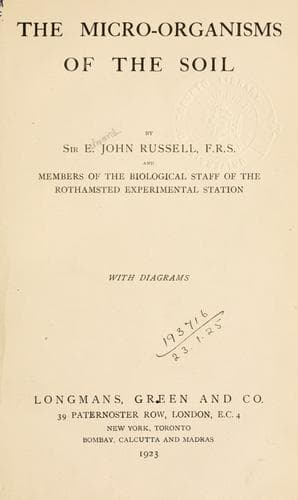
The micro-organisms of the soilRussell, Edward J. (Edward John)
Science
The micro-organisms of the soil
Russell, Edward J. (Edward John)
Soil microbiology
In comparing the bacterial numbers in two soil samples, however,
the case is different. Within each bacterial group investigated the
plate method should give counts proportional to the bacterial numbers
in the soil. Thus, by the method one should be able to tell whether
the bacterial numbers are increasing or decreasing over a period of
time, or whether a certain soil treatment produces an increase or
a decrease. With this end in view the technique of the method has
been improved by recent workers. It was found that, when carefully
standardised, the process of dilution of the soil could be carried
out without significant variation in result (Table IV.), and that the
accuracy of the method is limited mainly by the variation in colony
numbers on parallel platings, due in part to random distribution of
bacteria throughout the final suspension, and partly to the uneven
development of colonies on the medium. The question of the medium was
therefore taken up with a view to improving the uniformity of results
obtained with it. Lipman, Conn, and others effected an improvement by
using chemical compounds as nutrient ingredients, thus making their
media more closely reproducible. On most agar media, an important
disturbing factor is the growth of spreading colonies, which prevent
the development of some of the other colonies. A medium has been
devised at Rothamsted on which these spreading organisms are largely
restricted.[61] A statistical examination[19] has shown that on this
medium errors due to the uneven development of colonies, except in
special cases, are prevented, so that in fact the variation in colony
numbers between parallel plates is found to be that produced merely by
random distribution of bacteria in the diluted suspension (see Table
IV.). In this case the accuracy of the counts of the bacteria in the
diluted suspension depend directly on the number of colonies counted,
and can be known with precision.
TABLE IV.--BACTERIAL COUNTS OF A SOIL SAMPLE.
PARALLEL PLATE COUNTS FROM FOUR SETS OF DILUTIONS MADE BY DIFFERENT
WORKERS.
+------------------------------------------+
| Counts of Colonies on each Plate. |
+------+--------+--------+--------+--------+
|Plate.| Set I. | Set II.|Set III.| Set IV.|
+------+--------+--------+--------+--------+
| 1 | 72 | 74 | 78 | 69 |
| 2 | 69 | 72 | 74 | 67 |
| 3 | 63 | 70 | 70 | 66 |
| 4 | 59 | 69 | 58 | 64 |
| 5 | 59 | 66 | 58 | 62 |
| 6 | 53 | 58 | 56 | 58 |
| 7 | 51 | 52 | 56 | 54 |
+------+--------+--------+--------+--------+
| Mean | 60·86 | 65·86 | 64·28 | 62·86 |
+------+--------+--------+--------+--------+
Standard deviation between the four sets = 5·62.
Standard deviation between plates within the sets = 7·76.
Public-domain text, read in full here on John Shaqi.
Reviews
Reviews
No reviews yet
Be the first to share your thoughts on this work.
Join the Discussion
Join the discussion
Sign in to leave a comment or review.
Sign InorCreate an account