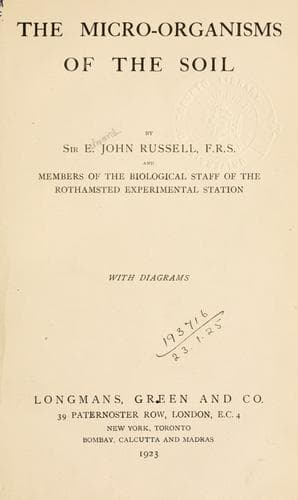
The micro-organisms of the soilRussell, Edward J. (Edward John)
Science
The micro-organisms of the soil
Russell, Edward J. (Edward John)
Soil microbiology
The knowledge obtained from counts of soil bacteria is subject to
another serious limitation. We do not know which of the bacteria
counted are the most effective in bringing about the various changes
that take place in the soil. It is not even known which of them are
active in the soil and which are in a resting condition. It is thus
possible to have two soils containing equal numbers of bacteria but
showing widely different biochemical activity, if one soil contains
organisms of a higher efficiency. Moreover, as has been pointed
out, many important groups of soil bacteria do not develop on the
plating media, and so are not counted. These considerations led to
the development of supplementary methods by which it was hoped to
estimate the actual biochemical activity of the soil microflora. The
first of these methods was developed by Remy, who attempted to study
the biochemical activity of a soil by placing weighed amounts into
sterile solutions of suitable and known composition, keeping them
under standard conditions for a definite time and then estimating the
amount of the chemical change that was being studied. Thus, to test the
activity of the organisms that produce ammonia from organic nitrogen
compounds, he inoculated soil into 1 per cent. peptone solution and
measured the amount of ammonia produced in a given time. By similar
methods the power of a soil to oxidise ammonia to nitrate, to reduce
nitrate, or to fix atmospheric nitrogen, is tested. This method has
been extensively used and developed by more recent workers. It suffers,
however, from the same serious disadvantage that it was designed to
avoid, for we cannot be certain that those bacteria that develop in
the nutrient solution are the types that are active in the soil, and,
moreover, even where the same types do function in the two conditions,
we do not know that the degree of their activity is the same in soil
and in solution cultures. For instance, _Nitrosomonas_ appears to show
very different degrees of activity in soil and in culture.
Public-domain text, read in full here on John Shaqi.
Reviews
Reviews
No reviews yet
Be the first to share your thoughts on this work.
Join the Discussion
Join the discussion
Sign in to leave a comment or review.
Sign InorCreate an account