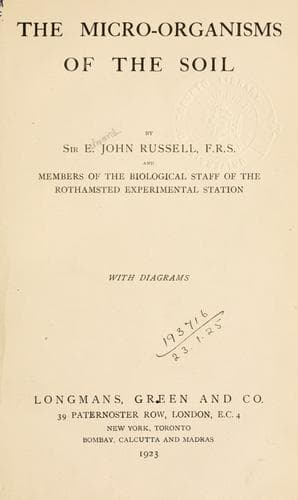
The micro-organisms of the soilRussell, Edward J. (Edward John)
Science
The micro-organisms of the soil
Russell, Edward J. (Edward John)
Soil microbiology
Since bacteria are dependent on adequate supplies of energy and food,
it is to be expected that additions of organic matter or of inorganic
food materials will greatly benefit their activities. The effect of
added farmyard manure in increasing bacterial activities has been much
studied.[27] Some of the increased bacterial numbers and activities
in this case may be due to the addition of bacteria with the manure,
but it is thought that this factor is of less importance than the
added energy and food supply which the general soil flora obtain from
it. Nutritive salts such as phosphates and salts of potassium usually
increase the bacterial activities.
The effect of alkali salts on soil bacteria has been especially studied
in the Western United States, where the existence of alkali in the
soil is a serious problem.[23] Soil bacteria are usually stimulated by
small doses of alkali salts that are toxic in higher concentration.
As a rule, chlorides are the most toxic salts, the electronegative
ion playing an important part in the effect of the salt. Salts
affect bacteria both owing to the changes in osmotic pressure which
they produce, and through their specific action on the bacterial
protoplasm.[26] When equal weights of various salts are added to soil,
their toxic action on bacteria shows so little association with their
respective osmotic pressures that we must conclude that this factor is
the less important. There is reason to suppose that the toxic action
of salts on bacteria is often connected with an effect of the specific
ions on the permeability of the bacterial cell-wall. This conclusion
is based on the changes in electrical conductivity of bacterial
suspensions in the presence of various salts.[59]
A definite antagonism between various salts has been found to exist.
It is possible that future work in this line may indicate what are
the proportions of common electrolytes which will produce a properly
“balanced” soil solution so that the harmful excess of one salt may be
antagonised.
Certain salts, such as those of arsenic[24] and manganese, seem to
exercise a stimulating action on bacterial activities; the causes of
this action are not at present understood.
The acidity of the soil has an important effect on the bacterial
processes. The acidity of soils may increase to such a point that the
decomposition of plant tissues by bacteria is hindered, a peat layer
being thus produced. The degree of acidity that is toxic varies very
greatly with different soil bacteria, some of them, like Azotobacter
and Nitrosomonas being very intolerant of acidity.
The conditions of aeration, water content, and temperature are
inter-related in field soil. Ammonifying organisms are not greatly
dependent on aeration, but this factor is sometimes a limiting one in
the case of the very aerobic nitrifying bacteria. Hence efficient soil
cultivation is beneficial to nitrification.
Public-domain text, read in full here on John Shaqi.
Reviews
Reviews
No reviews yet
Be the first to share your thoughts on this work.
Join the Discussion
Join the discussion
Sign in to leave a comment or review.
Sign InorCreate an account