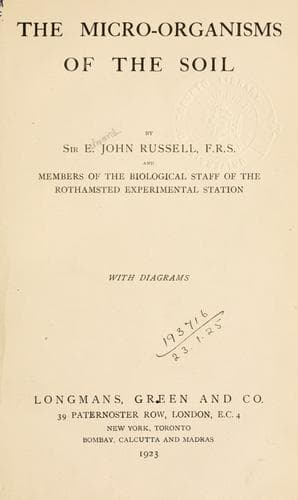
The micro-organisms of the soilRussell, Edward J. (Edward John)
Science
The micro-organisms of the soil
Russell, Edward J. (Edward John)
Soil microbiology
Since the bacteria involved in this fluctuation are of great importance
to the crops, being for the most part ammonia producing types, further
knowledge as to the cause of this fluctuation and of its effect on the
ammonia and nitrate in the soil is of fundamental importance. There is
evidence, which will be discussed later, that the cause is connected
with the changing activities of certain soil protozoa, since the daily
changes in the numbers of active amœbæ in the soil have been found
to be in the reverse direction to those of the bacterial numbers. It
appears, therefore, that we are dealing with an equilibrium between
the various members of the soil population, the point of equilibrium
changing at frequent intervals.
In addition to daily changes, it is possible to detect changes in the
numbers and activity of the soil population related to the season.
There is a well-marked increase in the spring and autumn (see Figs.
15, 16, pp. 89, 90). This is well seen when the fortnightly averages
of the daily bacterial and protozoal counts from Barnfield soil
are plotted. These spring and autumn increases comprise both the
bacterial and the protozoal population, and therefore differ from the
short time fluctuations in being due, not to a disturbance of the
bacteria-protozoa equilibrium, but to a general rise in activity of
both groups of organisms.
When we consider the action of external conditions on the soil
bacteria, the existence of a complex soil population and the
interdependence of its members must be borne in mind. Changes in
external conditions may affect the different components of the
population in different ways or to different degrees, thus upsetting
the equilibrium between the various groups. For example, the addition
of a mild aromatic antiseptic to the soil apparently affects the
protozoa in such a way as to disturb the bacteria-protozoa equilibrium
in favour of the bacteria, while in some cases the aromatic compound
affords a food supply to special bacteria, causing these to increase,
upsetting the equilibrium between the different bacterial groups. When
our knowledge of the effect of external factors on the soil population
becomes sufficient, it will probably be found that in nearly all
cases a change in the soil conditions produces some disturbance in
the equilibrium between the components of the soil population, though
at present there are only certain examples where this disturbance is a
probable explanation of the facts.
Public-domain text, read in full here on John Shaqi.
Reviews
Reviews
No reviews yet
Be the first to share your thoughts on this work.
Join the Discussion
Join the discussion
Sign in to leave a comment or review.
Sign InorCreate an account