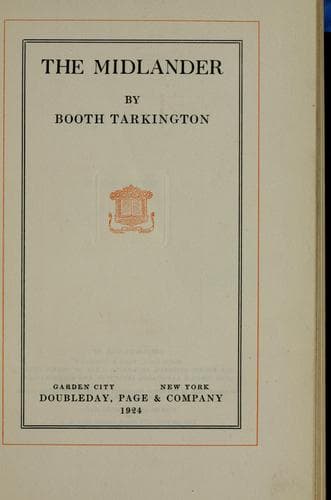
Middle West -- Fiction; Real estate developers -- Fiction; Suburbs -- Fiction
PEOPLE used to say of the two Oliphant brothers that Harlan Oliphant
looked as if he lived in the Oliphants’ house, but Dan didn’t. This was
a poor sort of information to any one who had never seen the house, but
of course the supposition was that everybody had seen it and was
familiar with its significance. It stood in a great, fine yard, in that
row of great, fine yards at the upper end of National Avenue, before the
avenue swung off obliquely and changed its name to Amberson Boulevard.
The houses in the long row were such houses as are built no more;
bricklayers worked for a dollar a day and the workman’s day was ten
hours long when National Avenue grew into its glory. Those houses were
of a big-walled solidity to withstand time, fire, and tornado, but they
found another assailant not to be resisted by anything: this conqueror,
called Progress, being the growth of the city. Until the growth came
they were indomitable and fit for the centuries.
Moreover, they were of a dignified spaciousness not now to be
accomplished except by millionaires with wives content to spend their
days getting new servants. The New Yorker, admitted to these interiors
upon a visit westward, discovered an amplitude with which he had little
familiarity at home, where the brownstone fronts and squeezed apartments
showed him no such suites of big rooms; for, of all the million people
in New York, only a dozen families could have houses comparable in size
or stateliness. “Stately” was the word, though here some little care
must be taken, of course, with an eye to those who will not admit that
anything short of Blenheim or the Luxembourg is stately. The stateliness
of the Oliphants’ house was precisely the point in that popular
discrimination between the two young men who lived there: Harlan
Oliphant, like the house, was supposed to partake of this high quality,
but stateliness was the last thing any one ever thought of in connection
with Dan.
The youth of the brothers, in the happy and comfortable nineties of the
last century, is well remembered in their city, where the Christmas
holidays could never be thought really begun till the two Oliphants had
arrived from college and their broad-shouldered, long-tailed coats and
incredibly high white collars were seen officially moving in the figures
of a cotillion. They usually arrived on the same day, though often not
by the same train; but this was the mark of no disagreement or avoidance
of each other, yet bore some significance upon the difference between
them. It was the fashion to say of them that never were two brothers so
alike yet so unlike; and although both were tall, with blue eyes, brown
hair, and features of pleasant contour decisively outlined in what is
called a family likeness, people who knew them well found it a
satisfying and insoluble puzzle that they were the offspring of the same
father and mother.
Public-domain text, read in full here on John Shaqi.
Reviews
Reviews
No reviews yet
Be the first to share your thoughts on this work.
Join the Discussion
Join the discussion
Sign in to leave a comment or review.
Sign InorCreate an account