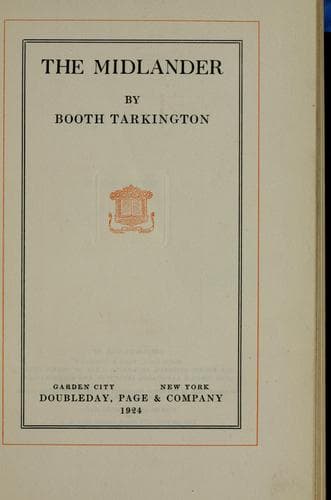
Middle West -- Fiction; Real estate developers -- Fiction; Suburbs -- Fiction
The contrast appeared in childhood and was manifest to even the casual
onlooker when Dan Oliphant was eleven or twelve years old and Harlan ten
or eleven. At that age Harlan was already an aristocrat, and, what is
more remarkable, kept himself always immaculate. If his collar rumpled
or was soiled he went immediately to his room and got a fresh one; he
washed his hands three or four times a day without parental suggestion
and he brushed his hair almost every time he washed his hands. He was
fastidious in his choice of companions, had no taste for chance
acquaintances, and on a school holiday could most frequently be found in
the library at home, reading a book beyond his years. The lively Daniel,
on the contrary, disported himself about the neighbourhood—or about
other neighbourhoods, for that matter—in whatever society offered him
any prospect of gayety. He played marbles “for keeps” with ragtag and
bobtail on every vacant lot in town; he never washed his hands or face,
or brushed his hair, except upon repeated command, yet loved water well
enough to “run off swimming” and dive through a film of ice upon an
early Saturday in March. He regaled himself with horseplay up and down
the alleys and had long talks with negro coachmen in their stables,
acquiring strange wisdom of them; he learned how to swear with some
intricacy, how to smoke almost anything not fireproof, how to “inhale,”
how to gamble with implements more sophisticated than marbles, and how
to keep all these accomplishments from the knowledge of his parents. He
kept them from Harlan’s knowledge, also, though not out of any fear that
Harlan would “tell.”
At some time in their early childhood the brothers had made the
discovery that they were uncongenial. This is not to say that they were
unamiable together, but that they had assumed a relation not wholly
unknown among brothers. They spoke to each other when it was necessary;
but usually, if they happened to find themselves together, they were
silent, each apparently unconscious of the other’s presence. Sometimes,
though rarely, they had a short argument, seldom upon a subject of great
importance; and only once did a difference between them attain the
dimensions of a quarrel.
This was on a summer day of feverish temperature, and the heat may have
had something to do with the emotion displayed by young Daniel, then
aged twelve. He was engaged, that afternoon, with a business friend,
Master Sam Kohn, and they were importantly busy in a latticed
summer-house, an ornament of the commodious lawn. They had entered into
a partnership for the sale of “Fancy Brackets and Fittings,” which they
manufactured out of old cigar boxes, with the aid of glue, a jig-saw,
and blue paint. The computed profits were already enormous, though no
sales had been attempted, since the glue was slow to harden on such a
hot day; and the partners worked diligently, glad to shed their
perspiration for the steadily increasing means to obtain riches.
Public-domain text, read in full here on John Shaqi.
Reviews
Reviews
No reviews yet
Be the first to share your thoughts on this work.
Join the Discussion
Join the discussion
Sign in to leave a comment or review.
Sign InorCreate an account