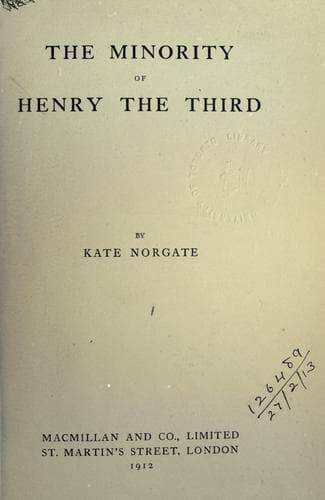
Great Britain -- History -- Henry III, 1216-1272; Henry III, King of England, 1207-1272
As early as 17th December, 1216, “the brave men of Ireland who are with
their ships on the coasts of Normandy” had been bidden, and encouraged
by the promise of liberal reward, to come in force to Winchelsea, ready
and prepared to go forth in the King’s service on S. Hilary’s day, or
as soon after as possible.[101] They seem to have obeyed the summons,
and to have been joined by an English fleet, gathered no doubt from
the loyal Cinque Ports, and commanded by the governor of the Channel
Islands, Philip d’Aubigné.[102] {Jan.} A detachment of Royalists,
protected by, if not actually landed from, these ships, had “by the
wise counsel of the Marshal” now surprised and occupied Rye.[103] Louis
at once set out for the coast; he went, however, not direct to Rye, but
to Winchelsea--still, it seems, intending to sail for France. At his
approach the burghers of Winchelsea broke up all the mills in their
town, and then took to their boats and went to join Philip d’Aubigné
and his fleet off Rye. Louis had no sooner entered Winchelsea than he
found himself caught in a trap whence there was no way of escape--shut
in between the new garrison of Rye, the ships, and the Weald, where
“Willikin” de Casinghem was still in command of a dauntless and
reckless band of loyalists who broke down every bridge and blocked
every passage in the rear of the French, and cut off the head of every
straggler who came within their reach.[104]
Louis and his men were soon on the verge of starvation; there was
plenty of corn in the town, but no means of grinding it save the slow
process of rubbing it between their hands; they could get neither flesh
nor fish; their “best food” consisted of some “large nuts” which they
found in the town. For a while they struggled on, making occasional
truces with the ships’ men, probably for the purpose of being able
to fish without molestation and thus procure a little food; but the
sailors paid little or no regard to these truces, and even came ashore
to shoot at the enemies.[105] At last Louis sent some messengers who
contrived to slip through the Weald to London for succour. Some of his
knights there set out to rescue their lord; but they dared not attempt
to pass through the Weald, so they went by the high road through
Canterbury to Romney, and thence--as it was impossible for them to
proceed from Romney to Winchelsea without passing Rye--despatched a
message to the governor of the county of Boulogne asking him to send
them all the ships he could get. He sent, it is said, over two hundred
vessels--probably only small boats--all of which save one came into
port at Dover, and were speedily occupied by the French knights who
hastened thither from Romney; but a succession of storms kept them
waiting a fortnight before they could sail. Meanwhile Louis and his men
had possessed themselves of several large ships which were lying in
the harbour of Winchelsea; and one of the vessels sent from Boulogne
Public-domain text, read in full here on John Shaqi.
Reviews
Reviews
No reviews yet
Be the first to share your thoughts on this work.
Join the Discussion
Join the discussion
Sign in to leave a comment or review.
Sign InorCreate an account