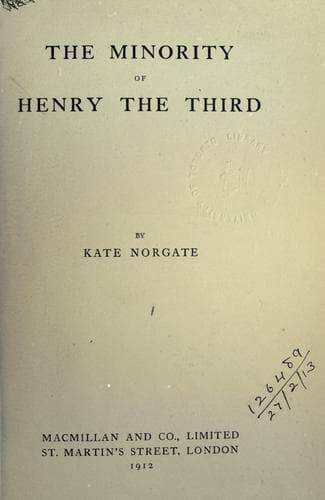
Great Britain -- History -- Henry III, 1216-1272; Henry III, King of England, 1207-1272
2. If there was a gate at the southern junction of the walls, it would
very probably be “of great antiquity”--as old as the second Roman
occupation of Lindum; for the wall itself thereabouts was certainly
Roman, as some fragments still remaining testify to this day. The
West Gate, on the other hand, in 1217 could not well be more than a
hundred and fifty years old. But the poet’s description of the blocked
gate as “une vielle porte qui ert de grant antequite” is a detail
which--like his use of the word _ancienement_ in l. 16509--need not
be taken literally. Such phrases, when used by even a prose writer
in an uncritical age, may mean almost anything; moreover, epithets
and descriptive phrases of all kinds when used by a medieval writer
of verse may occasionally mean nothing. The poet had probably never
seen the gate which he was describing; those who told him about it
were soldiers, not archæologists; neither he nor they could have a
very definite idea as to when it had been built, or how long it had
been obstructed. Possibly, however, his use of the expressions above
quoted may be accounted for in another way. Lincoln “above hill”
unquestionably possessed one gate which even in 1217 could hardly
fail to strike the most ignorant observer as being already “of great
antiquity.” Some of the poet’s informants may have mentioned this to
him, without specifying that it was the North Gate or giving it a name.
Others may have told him that the North Gate was called New Port.
If he was not further told that the “New Port” and the ancient gate
were identical, the fact of their identity could not possibly enter
his head; and as the North Gate and the blocked gate were evidently
the only two gates (of the city) which played any part in the day’s
fighting until it reached the Bar-Gate far away to the south beyond the
river, he would naturally conclude that since the first was the “new”
gate, the second must be the ancient one.
Public-domain text, read in full here on John Shaqi.
Reviews
Reviews
No reviews yet
Be the first to share your thoughts on this work.
Elsewhere in the archive
Join the Discussion
Join the discussion
Sign in to leave a comment or review.
Sign InorCreate an account