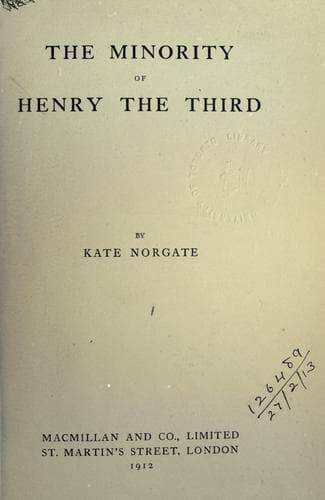
Great Britain -- History -- Henry III, 1216-1272; Henry III, King of England, 1207-1272
In the Irish dominions of the English Crown the first trouble that
arose under the new reign came neither from the barons nor from the
people, but from the Justiciar. Geoffrey de Marsh, who had held that
office in Ireland since 1215, no sooner heard of the death of King
John {1216} than he despatched to Henry, or to his guardians, letters
in which he assured his young sovereign of his fidelity, and asked
for instructions how to act for the furtherance of his interests in
Ireland. He seems to have suggested that the Queen-mother, or the
heir-presumptive, little Richard, should be sent thither to represent
the Crown.[464] The Marshal sent him in reply a letter in the King’s
name, informing him of the coronation and the proceedings of the
council of Bristol, and requesting him to receive for Henry the
homage of the magnates and the King’s other subjects in Ireland; also
promising to send them in return a confirmation of the same liberties
which had just been granted to their fellow-subjects in England.
The suggestion about the Queen and Richard was politely waived with
an assurance that it should be duly considered. Geoffrey was warmly
thanked for his past and present loyalty, and entreated to redouble
his efforts in behalf of a King whose tender years made him the more
in need of his liegemen’s counsel and aid.[465] On 6th February,
1217, a copy of the Charter was sent to Ireland with a letter in the
King’s name addressed to all the King’s faithful subjects in Ireland,
expressing his desire that as a reward for their fidelity to his
father and a motive for its continuance towards himself they and their
heirs for ever should, of his grace and gift, enjoy the same liberties
which his father and he had granted to the realm of England.[466]
The Marshal’s policy was to bind the English March in Ireland as
closely as possible to the Crown; he had already issued letters patent
forbidding the election of Irishmen to cathedral dignities within the
King’s land in Ireland, “because by such elections the peace of that
land has frequently been disturbed,” and commanding that when such
dignities fell vacant, clerks of the King and other “honest Englishmen
useful to us” (the King) “and our realm” should be elected and promoted
thereto by the joint counsel of the Archbishop of Dublin and the
Justiciar.[467] The Archbishop of Dublin, Henry of London, was at that
time in England; but on 16th April, “although,” writes the King to the
barons in Ireland, “we feel his presence here is most necessary to us
and our realm, and we can hardly do without his counsel,” he was sent
to “visit and console” his diocese, and also expressly to assist the
Justiciar with his counsel and support in ordering and amending the
condition of the King’s Irish territory; while the Justiciar was bidden
to “acquiesce in all things” in the counsel of the Archbishop, and to
be guided by it in his expenditure of the money received at the Dublin
Public-domain text, read in full here on John Shaqi.
Reviews
Reviews
No reviews yet
Be the first to share your thoughts on this work.
Elsewhere in the archive
Join the Discussion
Join the discussion
Sign in to leave a comment or review.
Sign InorCreate an account