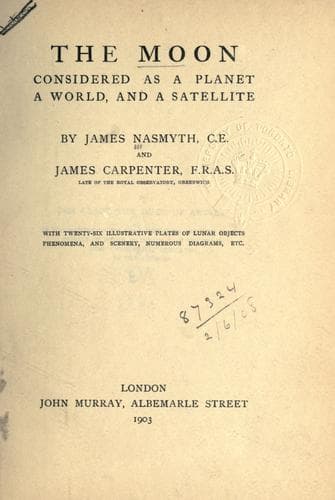
The Moon: considered as a planet, a world, and a satellite.Nasmyth, James
Science
The Moon: considered as a planet, a world, and a satellite.
Nasmyth, James
Moon
In justice to Professor Dana it should be stated that he included in
this theory of formation all lunar craters, even those of small size and
possessing central cones; and he put forth his views in opposition to
the eruptive theory which we have set forth, and which was briefly given
to the world more than twenty-five years ago. As regards the smallest
craters with cones, we believe few geologists will refuse their
compliance with the supposition that they were formed as our
crater-bearing volcanoes were formed: and we have pointed out the
logical impossibility of assigning any limit of size beyond which the
eruptive action could not be said to hold good, so long as the central
cone is present. But when we come to ring-mountains having no cones, and
of such enormous size that we are compelled to hesitate in ascribing
them to ejective action, we are obliged to face the possibility of some
other causation. And, failing an explanation of our own that satisfied
us, we have alluded to the few hypotheses proffered by others, and of
these Professor Dana’s appears the most rational, since it is based upon
a parallel found on the earth. In citing it, however, we do necessarily
not endorse it.
CHAPTER X.
PEAKS AND MOUNTAIN RANGES.
The lunar features next in order of conspicuity are the mountain ranges,
peaks, and hill-chains, a class of eminences more in common with
terrestrial formations than the craters and circular structures that
have engaged our notice in the preceding chapters.
Public-domain text, read in full here on John Shaqi.
Reviews
Reviews
No reviews yet
Be the first to share your thoughts on this work.
Elsewhere in the archive
Join the Discussion
Join the discussion
Sign in to leave a comment or review.
Sign InorCreate an account