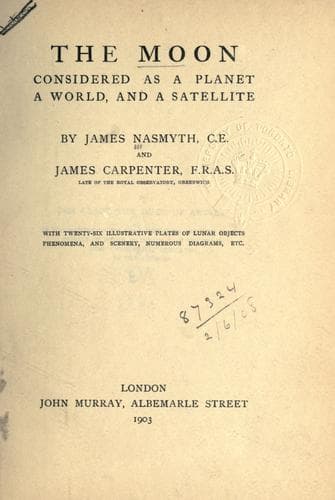
The Moon: considered as a planet, a world, and a satellite.Nasmyth, James
Science
The Moon: considered as a planet, a world, and a satellite.
Nasmyth, James
Moon
Seeing that volcanic action has had so large a share in giving to the
moon’s surface its structural character, analogy of the most legitimate
order justifies us in concluding not only that the materials of that
surface are of kindred nature to those of the unquestionably volcanic
portions of the earth, but also that the tints and colours that
characterize terrestrial volcanic and Plutonian products have their
counterparts on the moon. Those who have seen the interior and
surroundings of a terrestrial volcano after a recent eruption, and
before atmospheric agents have exercised their dimming influences, must
have been struck with the colours of the erupted materials themselves
and the varied brilliant tints conferred on these materials by the
sublimated vapours of metals and mineral substances which have been
deposited upon them. If, then, analogy is any guide in enabling us to
infer the appearance of the invisible from that which we know to be of
kindred nature and which we have seen, we may justly conclude that were
the moon brought sufficiently near to us to exhibit the minute
characteristics of its surface, we should behold the same bright and
varied colours in and around its craters that we behold in and about
those of the earth; and in all probability the coloured materials of
lunar volcanoes would be more fresh and vivid than those of the earth by
reason of the absence of those atmospheric elements which tend so
rapidly to impair the brightness of coloured surfaces exposed to their
influence.
Situated as we are, however, as regards distance from the moon, we have
no chance of perceiving these local colours in their smaller masses; but
it is by no means improbable, as we have suggested, that the faint tints
exhibited by the great plains are due to broad expanses of coloured
volcanic material.
But if we fail to perceive diversity of colour upon the lunar surface,
we are in a very different position in regard to diversity of brightness
or variable light-reflective power of different districts and details.
This will be tolerably obvious to those casual observers who have
remarked nothing more of the moon’s physiography than the resemblance to
a somewhat lugubrious human countenance which the full moon exhibits,
and which is due to the accidental disposition of certain large and
small areas of surface material which have less of the light-reflecting
property than other portions; for since all parts seen by a terrestrial
observer may be said to be equally shone upon by the sun, it is clear
that apparently bright and shaded parts must be produced by differences
in the nature of the surface as regards power of reflecting the light
received.
Public-domain text, read in full here on John Shaqi.
Reviews
Reviews
No reviews yet
Be the first to share your thoughts on this work.
Elsewhere in the archive
Join the Discussion
Join the discussion
Sign in to leave a comment or review.
Sign InorCreate an account