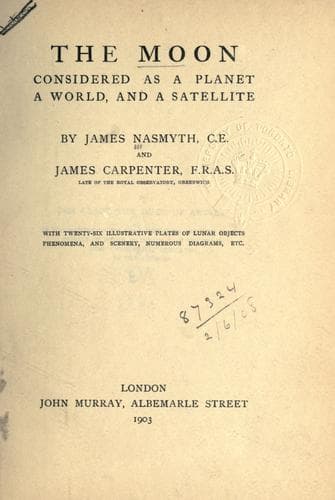
The Moon: considered as a planet, a world, and a satellite.Nasmyth, James
Science
The Moon: considered as a planet, a world, and a satellite.
Nasmyth, James
Moon
When we turn to the telescope and survey the full disc of the moon with
even a very moderate amount of optical aid, the meagre impression as to
variety of degree of brightness which the unassisted eye conveys is
vastly extended and enhanced, for the surface is seen to be diversified
by shades of brilliancy and dullness from almost glittering white to
sombre grey: and this variety of shading is rendered much more striking
by shielding the eye with a dusky glass from the excessive glare, which
drowns the details in a flood of light. Under these circumstances the
varieties of light and shade become almost bewildering, and defy the
power of brush or pencil to reproduce them.
We may, however, realize an imperfect idea of this characteristic of the
lunar surface by reference to the self-drawn portrait of the full moon
upon Plate III. This is, in fact, a photograph taken from the full moon
itself, and enlarged sufficiently to render conspicuous the spots and
large and small regions that are strikingly bright in comparison with
what may in this place be described as the “ground” of the disc. As an
example of a wide and irregularly extensive district of highly
reflective material, the region of which Tycho is the central object, is
very remarkable. We may refer also to the bright “splashes” of which
Copernicus and Kepler are the centres. So brilliant are these spots that
they can easily be detected by the unassisted eye about the time of full
moon. Still brighter but less conspicuous by its size is the crater
Aristarchus, which shines with specular brightness, and almost induces
the belief that its interior is composed of some vitreous-surfaced
matter: the highly reflective nature of this object has often caused it
to become conspicuous when in the dark hemisphere of the moon,
unilluminated by the sun, and lighted only by the light reflected from
the earth. At these times it appears so bright that it has been taken
for a volcano in actual eruption, and no small amount of popular
misconception at one time arose therefrom concerning the conditions of
the moon as respects existing volcanic activity—a misconception that
still clings to the minds of many.
Public-domain text, read in full here on John Shaqi.
Reviews
Reviews
No reviews yet
Be the first to share your thoughts on this work.
Elsewhere in the archive
Join the Discussion
Join the discussion
Sign in to leave a comment or review.
Sign InorCreate an account