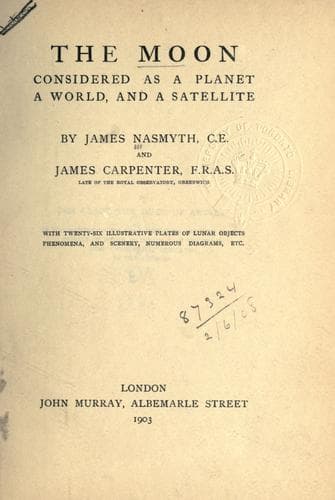
The Moon: considered as a planet, a world, and a satellite.Nasmyth, James
Science
The Moon: considered as a planet, a world, and a satellite.
Nasmyth, James
Moon
The parts of the surface distinguished by deficiency of reflecting power
are conspicuous enough. We may cite, however, as an example of a detail
portion especially remarkable for its dingy aspect, the interior of the
crater Plato, which is one of the darkest spots (the darkest well
defined one) upon the hemisphere of the moon visible to us. For
facilitating reference to shades of luminosity, Schroeter and Lohrman
assorted the variously reflective parts into 10 grades, commencing with
the darkest. Grades 1 to 3 comprised the various deep greys; 4 and 5 the
light greys; 6 and 7 white; and 8 to 10 brilliant white. The spots
Grimaldi and Riccioli came under class 1 of this notation; Plato between
1 and 2. The “seas” generally ranged from 2 to 3; the brightest
mountainous portions mostly between degrees 4 and 6; the crater walls
and the bright streaks came between these and the bright peaks, which
fell under the 9th grade. The maximum brightness, the 10th grade, is
instanced only in the ease of Aristarchus and a point in Werner, though
Proclus nearly approaches it, as do many bright spots, chiefly the sites
of minute craters, which make their appearance at the time of full moon.
In photographic pictures produced by the moon of itself, there is always
an apparent exaggeration in the relation of light to dark portions of
the disc. The dusky parts look, upon the photograph, much darker than to
the eye directed to the moon itself, whether assisted or not by optical
appliances. It may be that the real cause of this discrepancy is that
the eye fails to discover the actual difference upon the moon itself,
being insensible to the higher degrees of brightness or not estimating
them at their proper brilliance with respect to parts less bright. On
the other hand, it is probable that the enhanced contrast in the
photograph is due to some peculiar condition of the darker surface
matter affecting its power of reflecting the actinic constituent of the
rays that fall upon it.
Public-domain text, read in full here on John Shaqi.
Reviews
Reviews
No reviews yet
Be the first to share your thoughts on this work.
Elsewhere in the archive
Join the Discussion
Join the discussion
Sign in to leave a comment or review.
Sign InorCreate an account