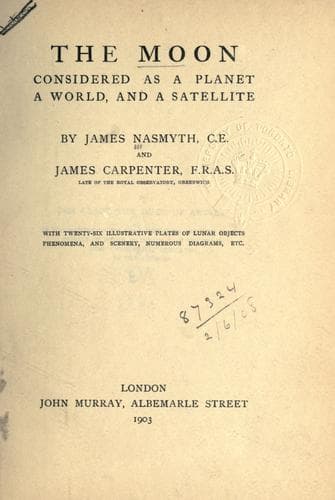
The Moon: considered as a planet, a world, and a satellite.Nasmyth, James
Science
The Moon: considered as a planet, a world, and a satellite.
Nasmyth, James
Moon
The study of the varying brightness or reflective power of different
regions and spots of the lunar disc leads us to the consideration of the
relative antiquity of the surface features; for it is hardly possible to
regard these variations attentively without being impressed with the
conviction that they have relation to some chronological order of
formation. We cannot, in the first place, resist the conviction that the
brightest features were the latest formed; this strikes us as evident on
_primâ facie_ grounds; but it becomes more clearly so when we remark
that the bright formations, as a rule, overlie the duller features. The
elevated parts of the crust are brighter than the “seas” and other
areas; and it is pretty clear that the former are newer than the latter,
upon which they appear to be super-imposed, or through which they seem
to have extruded.[13] The vast dusky plains are in every instance more
or less sprinkled with spots and minute craters, and these last were
obviously formed after the area that contains them. One is almost
disposed to place the order of formations in the order of relative
brightness, and so consider the dingiest parts the oldest and the
brightest spots and craters the newest features, though, in the absence
of an atmosphere competent to impair the reflective power of the surface
materials, we are unable to justify this classification by suggesting a
cause for such a deterioration by time as the hypothesis pre-supposes.
As we have entered upon the question of relative age of the lunar
features, we may remark that there are evidences of various epochs of
formation of particular classes of details, irrespective of their
condition in respect of brightness, or, as we may say, freshness of
material. As a rule, the large craters are older than the small ones.
This is proved by the fact that a large object of this class is never
seen to interfere with or overlap a small one. Those of nearly equal
size are, however, seen to overlap one another as though several
eruptions of equal intensity had occurred from the same source at
different points. This is strikingly instanced in the group of craters
situated in the position 35-141 on our map, the order of formation of
each of which is clearly apparent. The region about Tycho offers an
inexhaustible field for study of these phenomena of overlapping or
interpolating craters, and it will be found, with very few exceptions,
that the smaller crater is the impinging or parasitical one, and must
therefore have been formed after the larger, upon which it intrudes or
impinges. There are frequent cases in which a large crater has had its
rampart interrupted by a lesser one, and this again has been broken into
by one still smaller; and instances may be found where a fourth crater
smaller than all has intruded itself upon the previous intruder. The
general tendency of these examples is to show that the craters
diminished in size as the moon’s volcanic energy subsided: that the
Public-domain text, read in full here on John Shaqi.
Reviews
Reviews
No reviews yet
Be the first to share your thoughts on this work.
Elsewhere in the archive
Join the Discussion
Join the discussion
Sign in to leave a comment or review.
Sign InorCreate an account