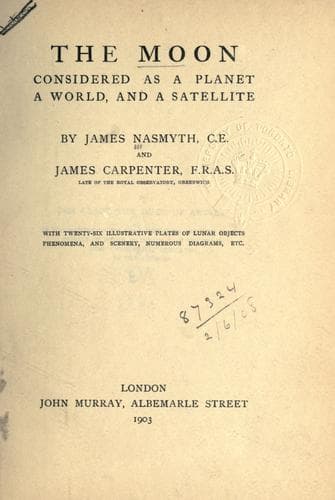
The Moon: considered as a planet, a world, and a satellite. — John Shaqi
The Moon: considered as a planet, a world, and a satellite.Nasmyth, James
Science
The Moon: considered as a planet, a world, and a satellite.
Nasmyth, James
Moon
The hypothesis of Buffon, however, is not sufficient to explain all the
phenomena of the planetary system; and it is imperfect, inasmuch as it
begins by assuming the sun to be already existing, whereas any theory
accounting for the primary formation of the solar system ought
necessarily to include the origination of the most important body
thereof, the sun itself. Nevertheless, it is but due to Buffon to
mention his ideas, for the errors of one philosophy serve a most useful
end by opening out fields of inquiry for subsequent and more fortunate
speculators.
Laplace, dissatisfied with Buffon’s theory, sought one more probable,
and thus was led to the proposition of the celebrated _nebular
hypothesis_ which bears his name, and which, in spite of its
disbelievers, has never been overthrown, but remains the only probable,
and, with our present knowledge, the only possible explanation of the
cosmical origin of the planets of our system. Although Laplace puts
forth his conjectures, to use his own words, “with the deference which
ought to inspire everything that is not a result of observation and
calculation,” yet the striking coincidence of all the planetary
phenomena with the conditions of his system gives to those conjectures,
again to use his modest language, “a probability strongly approaching
certitude.”
Laplace conceived the sun to have been at one period the nucleus of a
vast nebula, the attenuated surrounding matter of which extended beyond
what is now the orbit of the remotest planet of the system. He supposed
that this mass of matter in process of condensation possessed a rotatory
motion round its centre of gravity, and that the parts of it that were
situated at the limits where centrifugal force exactly counterbalanced
the attractive force of the nucleus were abandoned by the contracting
mass, and thus were formed successively a number of rings of matter
concentric with and circulating around the central nucleus. As it would
be improbable that all the conditions necessary to preserve the
stability of such rings of matter in their annular form could in all
cases exist, they would break up into masses which would be endued with
a motion of rotation, and would in consequence assume a spheroidal form.
These masses, which hence constituted the various planets, in their turn
condensing, after the manner of the parent mass, and abandoning their
outlying matter, would become surrounded by similarly concentric rings,
which would break up and form the satellites surrounding the various
planetary masses; and, as a remarkable exception to the rule of the
instability of the rings and their consequent breakage, Laplace cited
the case of Saturn surrounded by his rings as the only instances of
unbroken rings that the whole system offers us; unless indeed we include
the zodiacal light, that cone of hazy luminosity that is frequently seen
streaming from our luminary shortly before and after sunset, and which
Public-domain text, read in full here on John Shaqi.
Reviews
Reviews
No reviews yet
Be the first to share your thoughts on this work.
Join the Discussion
Join the discussion
Sign in to leave a comment or review.
Sign InorCreate an account