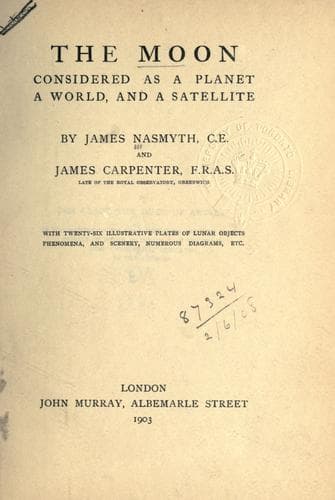
The Moon: considered as a planet, a world, and a satellite. — John Shaqi
The Moon: considered as a planet, a world, and a satellite.Nasmyth, James
Science
The Moon: considered as a planet, a world, and a satellite.
Nasmyth, James
Moon
“The total dissimilitude,” says Herschel at the close of the
observations we have alluded to, “between the appearance of a diffusion
of the nebulous matter and of a star, is so striking, that an idea of
the conversion of the one into the other can hardly occur to any one who
has not before him the result of the critical examination of the
nebulous system which has been displayed in this [his] paper. The end I
have had in view, by arranging my observations in the order in which
they have been placed, has been to show that the above mentioned
extremes may be connected by such nearly allied intermediate steps, as
will make it highly probable that every succeeding state of the nebulous
matter is the result of the action of gravitation upon it while in a
foregoing one, and by such steps the successive condensation of it has
been brought up to the planetary condition. From this the transit to the
stellar form, it has been shown, requires but a very small additional
compression of the nebulous matter.”
Where the researches of Herschel terminated those of Laplace commenced.
Herschel showed how a mass of nebulous matter so diffused as to be
scarcely discernible might be and probably was, by the mere action of
gravitation, condensed into a mass of comparatively small dimensions
when viewed in relation to the immensity of its primordial condition.
Laplace demonstrated how the known laws of gravitation could and
probably did from such a partially condensed mass of matter produce an
entire planetary system with all its subordinate satellites.
The first physicist who ventured to account for the formation of the
various bodies of our solar system was Buffon, the celebrated French
naturalist. His theory, which is fully detailed in his renowned work on
natural history, supposed that at some period of remote antiquity the
sun existed without any attendant planets, and that a comet having
dashed obliquely against it, ploughed up and drove off a portion of its
body sufficient in bulk to form the various planets of our system. He
suggests that the matter thus carried off “at first formed a torrent the
grosser and less dense parts of which were driven the farthest, and the
densest parts, having received only the like impulsion, were not so
remotely removed, the force of the sun’s attraction having retained
them:” that “the earth and planets therefore at the time of their
quitting the sun were burning and in a state of liquefaction;” that “by
degrees they cooled, and in this state of fluidity they took their
form.” He goes on to say that the obliquity of the stroke of the comet
might have been such as to separate from the bodies of the principal
planets small portions of matter, which would preserve the same
direction of motion as the principal planets, and thus would form their
attendant satellites.
Public-domain text, read in full here on John Shaqi.
Reviews
Reviews
No reviews yet
Be the first to share your thoughts on this work.
Join the Discussion
Join the discussion
Sign in to leave a comment or review.
Sign InorCreate an account