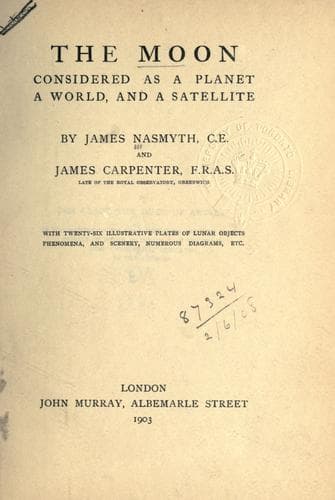
The Moon: considered as a planet, a world, and a satellite.Nasmyth, James
Science
The Moon: considered as a planet, a world, and a satellite.
Nasmyth, James
Moon
the distribution of clouds and vapours over the earth’s surface, as
comprehensive as that we are imagining, could really be obtained.
It might happen at “full-earth,” that a black spot with a fainter
penumbral fringe would appear on one side of the illuminated disc and
pass somewhat rapidly across it. This would occur when the moon passed
exactly between the sun and the earth, and the shadow of the moon was
cast upon the terrestrial disc. We need hardly say that these
shadow-transits would occur upon those astronomically important
occasions when an eclipse of the sun is beheld from the earth.
The other features of the sky during the long lunar night would not
differ greatly from those to which we alluded in speaking of its day
aspects. The stars would be the more brightly visible, from the greater
power of the eye-pupil to open in the absence of the glaring sun, and on
this account the milky-way would be very conspicuous and the brighter
nebulæ would come into view. The constellations would mark the night by
their positions, or the hours might be told off (in periods of
twenty-four each) by the successive reappearances of surface features on
certain parts of the terrestrial disc. The planets in opposition to the
sun would now be seen, and a comet might appear to vary the monotony of
the long lunar night. But a meteor would never flash across the sky,
though dark meteoric particles and masses would continually bombard the
lunar surface, sometimes singly, sometimes in showers. And these would
fall with a compound force due to their initial velocity added to that
of the moon’s attraction. As there is no atmosphere to consume the
meteors by frictional heat or break by its resistance the velocity of
their descent, they must strike the moon with a force to which that of a
cannon-ball striking a target is feeble indeed. A position on the moon
would be an unenviable stand-point from this cause alone.
Public-domain text, read in full here on John Shaqi.
Reviews
Reviews
No reviews yet
Be the first to share your thoughts on this work.
Elsewhere in the archive
Join the Discussion
Join the discussion
Sign in to leave a comment or review.
Sign InorCreate an account