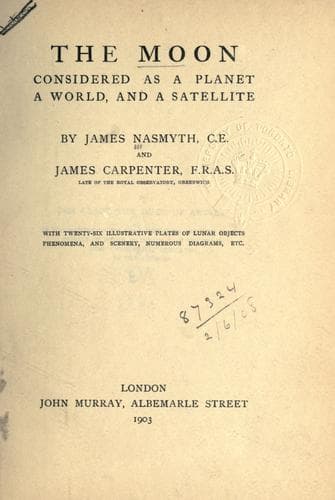
The Moon: considered as a planet, a world, and a satellite.Nasmyth, James
Science
The Moon: considered as a planet, a world, and a satellite.
Nasmyth, James
Moon
The lunar landscape by night needs little description: it would be lit
by the earth-moon sufficiently to allow salient features, even at a
distance, to be easily made out, for its moon (_i.e._ the earth) has
thirteen times the light-reflecting area that our’s has. But the night
illumination will change in intensity, since the earth-moon varies from
half-full to full, and again to half-full, between sunset and the next
sunrise. The direction of the light, and hence the positions of the
shadows, will scarcely alter on account of the apparent fixity of the
earth in the lunar sky. A slight degree of warmth might possibly be felt
with the reflected earth-light; but it would be insufficient to mollify
the intensity of the prevailing cold. The heat accumulated by the ground
during the three hundred hours’ sunshine radiates rapidly into space,
there being no atmospheric coat to retain it, and a cooling process
ensues that goes on till, all warmth having rapidly departed, the
previously parched soil assumes a temperature approaching that of
celestial space itself, and which has been, as we have stated, estimated
at about 200° below the Fahrenheit zero. If moisture existed upon the
moon, its night-side would be bound in a grip of frost to which our
Arctic regions would be comparatively tropical. But since there is no
water, the aspect of the lunar scenery remains unmodified by effects of
changing temperature.
Such, then, are the most prominent effects that would manifest
themselves to the visual and other senses of a being transported to the
moon. The picture is not on the whole a pleasant one, but it is
instructive; and our rendering of it, imperfect though it be, may serve
to suggest other inferences that cannot but add to the interest which
always attaches to the contemplation of natural scenes and phenomena
from points of view different from those which we ordinarily occupy.
[Illustration: PLATE XXIII.
GROUP of LUNAR MOUNTAINS. ideal lunar landscape.]
CHAPTER XIV.
THE MOON AS A SATELLITE: ITS RELATION TO THE EARTH AND MAN.
Apart from the recondite functions of the moon considered as one of the
interdependent members of the solar family, into which it would be
beyond our purpose to inquire, there are certain means by which it
subserves human interests and ministers to the wants of civilized man to
which we deem it desirable to call attention, especially as some of them
are not so self-apparent as to have attracted popular attention.
Public-domain text, read in full here on John Shaqi.
Reviews
Reviews
No reviews yet
Be the first to share your thoughts on this work.
Elsewhere in the archive
Join the Discussion
Join the discussion
Sign in to leave a comment or review.
Sign InorCreate an account