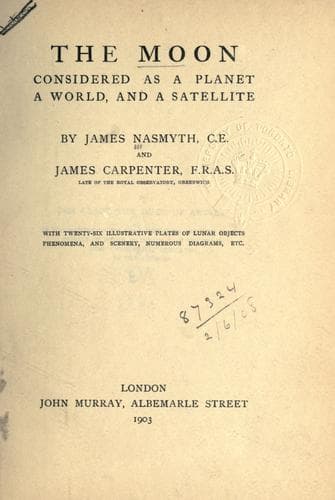
The Moon: considered as a planet, a world, and a satellite.Nasmyth, James
Science
The Moon: considered as a planet, a world, and a satellite.
Nasmyth, James
Moon
But the truths of nature are for ever playing at hide and seek with
those who follow them:—the dogmas of one era are the exploded errors of
the next. Within the past few years a new science has arisen that
furnishes us with fresh powers of penetration into the vast and secret
laboratories of the universe; a new eye, so to speak, has been given us
by which we may discern, by the mere light that emanates from a
celestial body, something of the chemical elements of which it is
composed. When Newton two hundred years ago toyed with the prism he
bought at Stourbridge fair, and projected its pretty rainbow tints upon
the wall, his great mind little suspected that that phantom riband of
gorgeous colours would one day be called upon to give evidence upon the
probable cosmical origin of worlds. Yet such in truth has been the case.
Every substance when rendered luminous gives off light of some colour or
degree of refrangibility peculiar to itself, and although the eye cannot
detect any difference between one character of light and another, the
prism gives the means of ascertaining the quality and degree of
refrangibility of the light emanating from any source however distant,
and hence of gaining some knowledge of the nature of that source. If,
for instance, a ray of light from a solid body in combustion is passed
through a prism, a spectrum is produced which exhibits light of all
colours or all degrees of refrangibility; if the light from such a body,
before passing through the prism, be made to pass through gases or
certain metallic vapours, the resulting spectrum is found to be crossed
transversely by numbers of fine dark lines, apparently separating the
various colours, or cutting the spectrum into bands. The solar spectrum
is of this class; the once mysterious lines first observed by Wollaston,
and subsequently by Fraunhoffer, and known as “Fraunhoffer’s lines,”
have now been interpreted, chiefly by the sagacious German chemist
Kirchoff, and identified as the effects of absorption of certain of the
sun’s rays by chemical vapours contained in his atmosphere. The fixed
stars yield spectra of the same character, but varying considerably in
feature, the lines crossing the stellar spectra differing in position
and number from those of the sun, and one star from another, proving the
stars to possess varied chemical constitutions. But there is another
class of spectra, exhibited when light from other sources is passed
through the prism. These consist, not of a luminous riband of light like
the solar spectrum, but of bright isolated lines of coloured light with
comparatively wide dark spaces separating them. Such spectra are yielded
only by the light emitted from luminous gases and metals or chemical
elements in the condition of incandescent vapour. Every gas or element
in the state of luminous vapour yields a spectrum peculiar to itself,
and no two elements when vapourized before the prism show the same
combinations of luminous lines.
Public-domain text, read in full here on John Shaqi.
Reviews
Reviews
No reviews yet
Be the first to share your thoughts on this work.
Join the Discussion
Join the discussion
Sign in to leave a comment or review.
Sign InorCreate an account