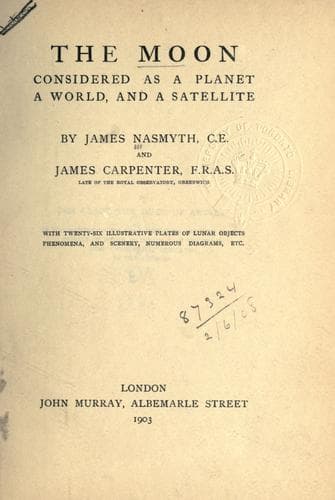
The Moon: considered as a planet, a world, and a satellite.Nasmyth, James
Science
The Moon: considered as a planet, a world, and a satellite.
Nasmyth, James
Moon
Now in the course of some observations upon the spectra of the fixed
stars by Dr. Huggins, it occurred to that gentleman to turn his
telescope, armed with a spectroscope, upon some of the brighter of the
nebulæ, and great was his surprise to find that instead of yielding
continuous spectra, as they must have done had their light been made up
of that of a multitude of stars, they gave spectra containing only two
or three isolated bright lines; such a spectrum could only be produced
by some luminous gas or vapour, and of this form of matter we are now
justified in declaring, upon the strength of numerous modern
observations, these remarkable bodies are composed; and it is a curious
and interesting fact that some of the nebulæ styled resolvable, from the
fact of their exhibiting points of light like stars, yield these gaseous
spectra, whence Dr. Huggins concludes that the brighter points taken for
stars are in reality nuclei of greater condensation of the nebular
matter: and so the fact of the apparent resolvability of a nebula
affords no positive proof of its non-nebulous character.
These observations—which have been fully confirmed by Father Secchi of
the Roman College—by destroying the evidence in favour of nebulæ being
remote clusters, add another attestation to the probability of the truth
of the nebular hypothesis, and we have now the confutation of the
luminologist to add to that of the astronomers who, in the person of the
illustrious Arago, asserted that the ideas of the great author of the
“Mécanique Céleste” “were those only which by their grandeur, their
coherence, and their mathematical character could be truly considered as
forming a physical cosmogony.”
Confining, then, our attention to the single object of the universe it
is our task to treat of—the Moon—and without asserting as an
indisputable fact that which we can never hope to know otherwise than by
inference and analogy, we may assume that that body once existed in the
form of a vast mass of diffused or attenuated matter, and that, by the
action of gravitation upon the particles of that matter, it was
condensed into a comparatively small and compact planetary body.
But while the process of condensation or compaction was going on,
another important law of nature—but recently unfolded to our
knowledge—was in powerful operation, the discussion of which law we
reserve for a separate Chapter.
CHAPTER II.
THE GENERATION OF COSMICAL HEAT.
Public-domain text, read in full here on John Shaqi.
Reviews
Reviews
No reviews yet
Be the first to share your thoughts on this work.
Join the Discussion
Join the discussion
Sign in to leave a comment or review.
Sign InorCreate an account