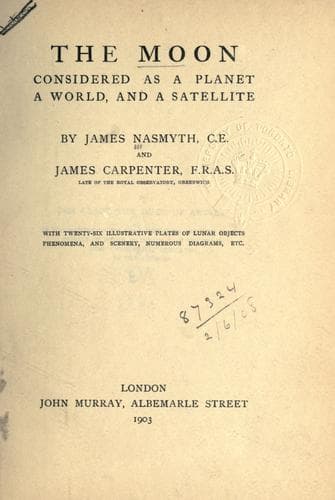
The Moon: considered as a planet, a world, and a satellite.Nasmyth, James
Science
The Moon: considered as a planet, a world, and a satellite.
Nasmyth, James
Moon
almost inappreciable among the grosser irregularities that arise from
other and as yet unexplained causes.
The lunar influences upon our atmosphere most likely to be detected are
those of a tidal character, and those due to the radiation of the heat
which the moon receives from the sun. The first would be shown by the
barometer, which may be called an “atmospheric tide gauge.” Some years
ago Sir Edward Sabine instituted a series of observations at St. Helena,
to determine the variations of barometric indications from hour to hour
of the lunar day. The greatest differences were found to occur between
the times when the moon was on the meridian, and when it was six hours
away from the meridian; in other words, between atmospheric high tide
and low tide. But the average of these differences amounted only to the
four-hundredth part of an inch on the instrument’s scale; a quantity
that no weather observer would heed, that none but the best barometers
would show, and that can have no perceptible effect on weather changes.
The distance of the moon from the earth varies, as is well known, in
consequence of the elliptical form of her orbit: this variation ought
also to produce an effect upon the instrument’s indications; but Colonel
Sabine’s analysis showed that it was next to insensible; the mean
reading at apogee differing from that at perigee by only the
two-thousandth part of an inch. Schubler, a German meteorologist, had
arrived at similarly negative results some years previously. Hence it
appears that the great index of the weather is not sensibly affected by
the state of the moon: the conclusion to be drawn with regard to the
weather itself is obvious enough. As regards the heat received from the
moon, we know, from the recent experiments of Lord Rosse in England, and
Marie Davy in France, elsewhere alluded to, that a degree of warmth
appreciable to the highly sensitive thermopile is exerted by the moon
upon the earth near to the time of full moon, when the sun’s rays have
been pouring their unmitigated heat upon the lunar surface continuously
for fourteen days. And as it is improbable that the whole of the heat
sent earthwards from the moon reaches the earth’s surface, we must infer
that a considerable amount is absorbed in the higher atmosphere, and
does work in evaporating the lighter clouds and thinning the denser
ones. The effect of this upon the earth is to facilitate the radiation
of its heat into space, and so to cool the lower atmospheric strata. And
this effect has been shown to be a veritable one by an exhaustive
tabulation of temperature records from various observatories, which was
undertaken by Mr. Park Harrison. The general conclusion from these was,
that the temperature at the earth’s surface is lower by about 2½ degrees
at moon’s last quarter than at first quarter; the paradoxical result
being what would naturally follow from the foregoing consideration. The
tendency of the full moon to clear the sky has been remarked by several
Public-domain text, read in full here on John Shaqi.
Reviews
Reviews
No reviews yet
Be the first to share your thoughts on this work.
Elsewhere in the archive
Join the Discussion
Join the discussion
Sign in to leave a comment or review.
Sign InorCreate an account