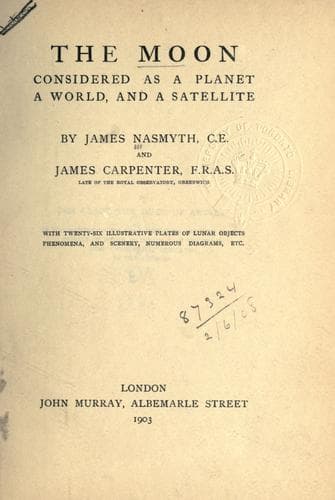
The Moon: considered as a planet, a world, and a satellite.Nasmyth, James
Science
The Moon: considered as a planet, a world, and a satellite.
Nasmyth, James
Moon
distinguished authorities, to wit, Sir John Herschel, Humboldt, and
Arago; and in general the clearing may be accepted as a meteorological
fact, though in one case of close examination it has been negatived. It
cannot be doubted that a full moon sometimes shows a night to be clear
that would in the absence of the moon be called cloudy.
When close comparisons are made between the moon’s positions and records
of rain-fall and wind-direction, dim indications of relation exhibit
themselves, which may be the feeble consequences of the change of
temperature just spoken of; but in every case where an effect has been
traced it has been of the most insignificant kind, and no apparent
connexion has been recognized between one effect and another. Certainly
there is nothing that can support the extensive popular belief in lunar
influence on weather, and nothing that can modify the conviction that
this belief as at present maintained is an absurd delusion. Yet its
acceptance is so general, and runs through such varied grades of
society, that we have felt it our duty to dwell upon it to the extent
that we have done.
CHAPTER XV.
CONCLUDING SUMMARY.
Having arrived at the conclusion of our subject, it appears to us
desirable that we should recall to the reader, by a rapid review, its
salient features.
Our main object being to attempt what we conceived to be a rational
explanation of the surface details of the moon which should be in
accordance with the generally received theory of planetary formation,
and with the peculiar physical conditions of the lunar globe—the opening
of our work was a summary of the nebular hypothesis as it was started by
the first Herschel and systemised by Laplace. Following these
philosophers we endeavoured to show how a chaotic mass of primordial
matter existing in space would, under the action of gravitation, become
transformed into a system of planetary bodies circulating about a common
centre of gravity; and further, how, in some cases, the circulating
planetary masses would themselves become sub-centres of satellitic
systems; our earth being one of these sub-centres with only one
satellitic attendant—to wit, the moon, the subject of our study.
The moon being thus considered as evolved from the parent nebulous mass,
and existing as an isolated and compact body, we had next to consider
what was the effect of the continued action of the gravitating force. By
the light of the beautiful “mechanical theory of heat” we argued that
this force, not being _destructible_, but being _convertible_, was
turned into heat; and that whatever may have been the original condition
of the parent nebulous mass, as regards temperature, its planetary
offspring became elevated to an intense degree of heat as they assumed
the form of spheres under the influence of gravitation.
Public-domain text, read in full here on John Shaqi.
Reviews
Reviews
No reviews yet
Be the first to share your thoughts on this work.
Elsewhere in the archive
Join the Discussion
Join the discussion
Sign in to leave a comment or review.
Sign InorCreate an account