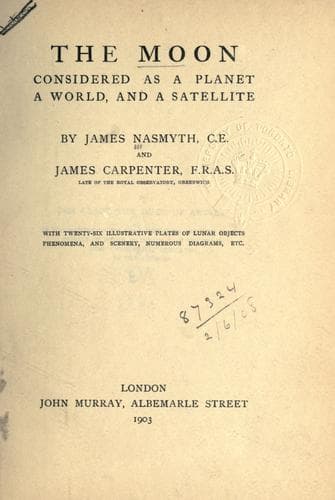
The Moon: considered as a planet, a world, and a satellite.Nasmyth, James
Science
The Moon: considered as a planet, a world, and a satellite.
Nasmyth, James
Moon
By a process entirely different, and by an independent course of
reasoning, Mayer had, a few months previous to Joule, determined this
equivalent to be 771·4 foot-pounds. Such a remarkable coincidence
arrived at by pursuing different routes gives this value a strong claim
to accuracy, and raises the Mechanical Theory of Heat to the dignity of
an exact science, and its enunciators to the foremost place in the ranks
of physical philosophers.
In linking together the labours of the two remarkable men above alluded
to, Prof. Tyndall remarks, that “Mayer’s labours have in some measure
the stamp of profound intuition, which rose however to the energy of
undoubting conviction in the author’s mind. Joule’s labours, on the
contrary, are an experimental demonstration. Mayer _thought_ his theory
out, and rose to its grandest applications. Joule _worked_ his theory
out, and gave it the solidity of natural truth. True to the speculative
instinct of his country, Mayer drew large and mighty conclusions from
slender premises; while the Englishman aimed above all things at the
firm establishment of facts.... To each belongs a reputation which will
not quickly fade, for the share he has had, not only in establishing the
dynamical theory of heat, but also in leading the way towards a right
appreciation of the general energies of the universe.”
But from these generalities we must pass to the application of the
mechanical theory of heat to our special subject. We have learnt that
every form of motion is convertible into heat. We know that the falling
meteor or shooting star, whose motion is impeded by friction against the
earth’s atmosphere, is heated thereby to a temperature of incandescence.
Let us then suppose that myriads of such cosmical particles came into
collision from the effect of their mutual attraction, or that the
component atoms of a vast nebulous mass violently converged under the
like influence. What would follow? Obviously the generation of an
intense heat by the arrest of converging motion, such a heat as would
result in the fusion of the whole into one mass. Mayer, in one of his
most remarkable papers (“Celestial Dynamics”) remarks that the
“Newtonian theory of gravitation, whilst it enables us to determine,
from its present form, the earth’s state of aggregation in ages past, at
the same time points out to us a source of heat powerful enough to
produce such a state of aggregation—powerful enough to melt worlds: it
teaches us to consider the molten state of a planet as the result of the
mechanical union of cosmical masses, and to derive the radiation of the
sun and the heat in the bowels of the earth from a common origin.”
Public-domain text, read in full here on John Shaqi.
Reviews
Reviews
No reviews yet
Be the first to share your thoughts on this work.
Join the Discussion
Join the discussion
Sign in to leave a comment or review.
Sign InorCreate an account