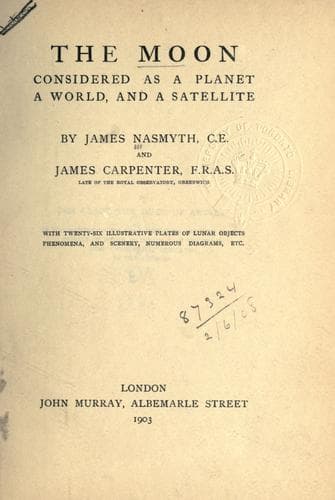
The Moon: considered as a planet, a world, and a satellite.Nasmyth, James
Science
The Moon: considered as a planet, a world, and a satellite.
Nasmyth, James
Moon
Next in order of publication of his results stands the name of Colding,
a Danish engineer, who about the year 1843 presented a series of memoirs
on the steam engine to the Royal Society of Copenhagen, in which he put
forth views almost identical with those of Mayer.
Last in publication order, but foremost in the importance of his
experimental treatment of the subject, was our own countryman, Dr. Joule
of Manchester. “Entirely independent of Mayer, with his mind firmly
fixed upon a principle, and undismayed by the coolness with which his
first labours appear to have been received, he persisted for years in
his attempts to prove the invariability of the relation which subsists
between heat and ordinary mechanical power.” (We are quoting from
Professor Tyndall’s valuable work on “Heat considered as a Mode of
Motion.”) “He placed water in a suitable vessel, agitated the water by
paddles, and determined both the amount of heat developed by the
stirring of the liquid and the amount of labour expended in its
production. He did the same with mercury and sperm oil. He also caused
discs of cast iron to rub against each other, and measured the heat
produced by their friction, and the force expended in overcoming it. He
urged water through capillary tubes, and determined the amount of heat
generated by the friction of the liquid against the sides of the tubes.
And the results of his experiments leave no shadow of doubt upon the
mind that, under all circumstances, the quantity of heat generated by
the same amount of force is fixed and invariable. A given amount of
force, in causing the iron discs to rotate against each other, produced
precisely the same amount of heat as when it was applied to agitate
water, mercury, or sperm oil. * * * * _The absolute amount of heat_
generated by the same expenditure of power, was in all cases the same.”
“In this way it was found that the quantity of heat which would raise
one pound of water one degree Fahrenheit in temperature, is exactly
equal to what would be generated if a pound weight, after having fallen
through a height of 772 feet, had its moving force destroyed by
collision with the earth. Conversely, the amount of heat necessary to
raise a pound of water one degree in temperature, would, if all applied
mechanically, be competent to raise a pound weight 772 feet high, or it
would raise 772 pounds one foot high. The term ‘foot pounds’ has been
introduced to express in a convenient way the lifting of one pound to
the height of a foot. Thus the quantity of heat necessary to raise the
temperature of a pound of water one degree Fahrenheit being taken as a
standard, 772 foot-pounds constitute what is called the _mechanical
equivalent_ of heat.”
Public-domain text, read in full here on John Shaqi.
Reviews
Reviews
No reviews yet
Be the first to share your thoughts on this work.
Join the Discussion
Join the discussion
Sign in to leave a comment or review.
Sign InorCreate an account