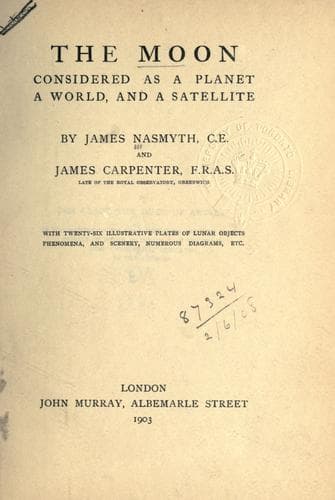
The Moon: considered as a planet, a world, and a satellite.Nasmyth, James
Science
The Moon: considered as a planet, a world, and a satellite.
Nasmyth, James
Moon
It is requisite here to remark that fusion does not necessarily imply
combustion. It has been frequently asked, How can a volcanic theory of
the lunar phenomena be upheld consistently with the condition that it
possesses no atmosphere to support Fire? To this we would reply that to
produce a state of incandescence or a molten condition it is _not_
necessary that the body be surrounded by an atmosphere. The intensely
rapid motion of the particles of matter of bodies, which the dynamical
theory shows to be the origin of the molten state, exists quite
independently of such external matter as an atmosphere. The complex
mixture of gases and vapours which we term “air,” has nothing whatever
to do with the fusion of substances, whatever it may have to do with
their combustion. Combustion is a chemical phenomenon, due to the
combination of the oxygen of that air with the heated particles of the
combustible matter: oxygen is the sole supporter of combustion, and
hence combustion is to be regarded rather as a phenomenon of oxygen than
as a phenomenon of the matter with which that oxygen combines. The
greatest intensity of heat may exist without oxygen, and consequently
without combustion. In support of this argument it will be sufficient to
adduce, upon the authority of Dr. Tyndall, the fact that a platinum wire
can be raised to a luminous temperature and actually _fused_ in a
perfect vacuum.
But while the mass of condensing cosmical matter was thus accumulating
and forming the globe of the moon, the heat consequent upon the
aggregation of its particles was suffering some diminution from the
effect of radiation. So long as the radiated heat lost fell short of the
dynamical heat generated, no effect of cooling would be manifest; but
when the _vis viva_ of the condensing matter was all converted into its
equivalent of heat, or when the accession of heat fell short of that
radiated, a necessary cooling must ensue, and this cooling would be
accompanied by a solidification of that part of the mass which was most
free to radiate its heat into surrounding space: that part would
obviously be the outer surface.
With the solidification of this external crust began the “year one” of
selenological history.
The phenomena attendant upon the cooling of the mass we will consider in
the next Chapter.
CHAPTER III.
THE SUBSEQUENT COOLING OF THE IGNEOUS BODY.
Public-domain text, read in full here on John Shaqi.
Reviews
Reviews
No reviews yet
Be the first to share your thoughts on this work.
Join the Discussion
Join the discussion
Sign in to leave a comment or review.
Sign InorCreate an account