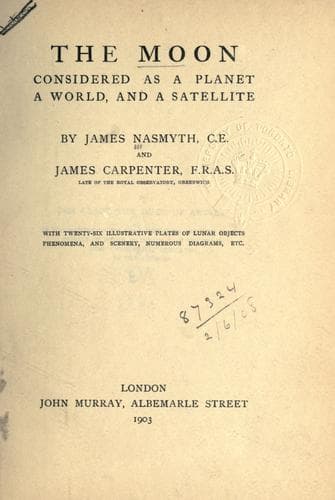
The Moon: considered as a planet, a world, and a satellite.Nasmyth, James
Science
The Moon: considered as a planet, a world, and a satellite.
Nasmyth, James
Moon
In the foregoing Chapters we have endeavoured to show, by the light of
modern science, first, how diffused cosmical matter was probably
condensed into a planetary mass by the mutual gravitation of its
particles, and secondly, how, the after destruction of the gravitative
force, by the collision of the converging particles of matter, resulted
in the generation of such sufficient heat as to reduce the whole mass to
a molten condition. Our present task is to consider the subsequent
cooling of the mass, and the phenomena attendant upon or resulting
therefrom. This brief Chapter is important to our subject, as we shall
have frequent occasion to refer to the leading principle we shall
endeavour to illustrate in it, in subsequently treating of the causes to
which the special selenological features are to be attributed.
First, then, as regards the cooling of the igneous mass that constituted
the moon at the inconceivably remote period when possibly that body was
really a “lesser light” shining with a luminosity of its own, due to its
then incandescent state, and not simply a reflector, as it is now, of
light which it receives from the sun. If we could conceive it possible
that the igneous mass in the act of cooling parted with its heat from
the central part first and so began to solidify from its centre, or if
it had been possible for the mass to have cooled uniformly and
simultaneously throughout its whole depth, or that each substratum had
cooled before its superstratum, we should have had a moon whose surface
would have been smooth and without any such remarkable asperities and
excresences as are now presented to our view. But these suppositions are
inadmissible: on the contrary we are compelled to consider that the
portion of the igneous or molten body that first cooled was its exterior
surface, which, radiating its heat into surrounding space, became solid
and comparatively cool while the interior retained its hot and molten
condition. So that at this early stage of the moon’s history it existed
in the form of a solid shell inclosing a molten interior.
Now at this period of its formation, the moon’s mass, partly cooled and
solidified and partly molten, would be subject to the influence of two
powerful molecular forces: the first of these would consist in the
diminution of bulk or contraction of volume which accompanies the
cooling of solidified masses of previously molten substances; the second
would arise from a phenomenon which we may here observe is by no means
so generally known as from its importance it deserves to be: and as we
shall have frequent occasion to refer to it as one of the chief agencies
in producing the peculiar structural characteristics of the moon’s
surface, it may be well here to give a few examples of its action, that
our reference to it hereafter may be more clearly understood.
Public-domain text, read in full here on John Shaqi.
Reviews
Reviews
No reviews yet
Be the first to share your thoughts on this work.
Join the Discussion
Join the discussion
Sign in to leave a comment or review.
Sign InorCreate an account