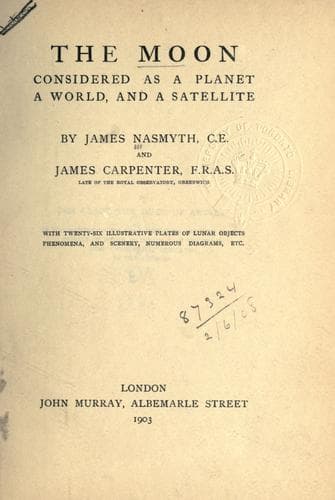
The Moon: considered as a planet, a world, and a satellite. — John Shaqi
The Moon: considered as a planet, a world, and a satellite.Nasmyth, James
Science
The Moon: considered as a planet, a world, and a satellite.
Nasmyth, James
Moon
The broad general principle of the phenomenon here referred to is
this:—that fusible substances are (with a few exceptions) specifically
heavier while in their molten condition than in the solidified state, or
in other words, that molten matter occupies less space, weight for
weight, than the same matter after it has passed from the melted to the
solid condition. It follows as an obvious corollary that such substances
contract in bulk in fusing or melting, and expand in becoming solid. It
is this expansion upon solidification that now concerns us.
Water, as is well known, increases in density as it cools, till it
reaches the temperature of 39° Fahrenheit, after which, upon a further
decrease of temperature, its density begins to decrease, or in other
words its bulk expands, and hence the well-known fact of ice floating in
water, and the inconvenient fact of water-pipes bursting in a frost.
This action in water is of the utmost importance in the grand economy of
nature, and it has been accepted as a marvellous exception to the
general law of substances increasing in density (or shrinking) as they
decrease in temperature. Water is, however, by no means the exceptional
substance that it has been so generally considered. It is a fact
perfectly familiar to iron-founders, that when a mass of solid cast-iron
is dropped into a pot of molten iron of identical quality, the solid is
found to float persistently upon the molten metal—so persistently that
when it is intentionally thrust to the bottom of the pot, it rises again
the moment the submerging agency is withdrawn. As regards the amount of
buoyancy we believe it may be stated in round numbers to be at least two
or three per cent. It has been suggested by some who are familiar with
this phenomenon that the solid mass may be kept up by a spurious
buoyancy imparted to it by a film of adhering air, or that surface
impurities upon the solid metal may tend to reduce the specific gravity
of the mass and thereby prevent it sinking, and that the fact of
floatation is not absolutely a proof of greater specific lightness. But
in controversion of these suggestions, we can state as the result of
experiment that pieces of cast-iron which have had their surface
roughness entirely removed, leaving the bright metal exposed, still
float on the molten metal, and further that when, under the influence of
the great heat of the molten mass, the solid is gradually melted away,
and consequently any possible surface impurities or adhering air must
necessarily have been removed, the remaining portion continues to float
to the last. The inevitable inference from this is that in the case of
cast-iron the solid is specifically lighter than the molten, and,
therefore, that in passing from the molten to the solid condition this
substance undergoes expansion in bulk.
Public-domain text, read in full here on John Shaqi.
Reviews
Reviews
No reviews yet
Be the first to share your thoughts on this work.
Join the Discussion
Join the discussion
Sign in to leave a comment or review.
Sign InorCreate an account