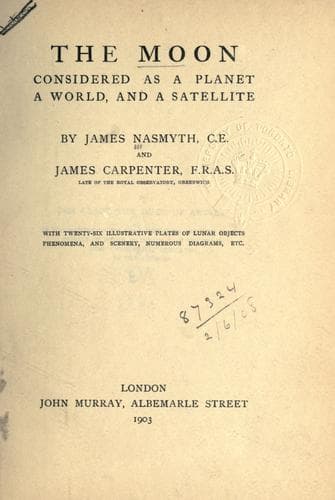
The Moon: considered as a planet, a world, and a satellite. — John Shaqi
The Moon: considered as a planet, a world, and a satellite.Nasmyth, James
Science
The Moon: considered as a planet, a world, and a satellite.
Nasmyth, James
Moon
Next, we come to what is technically termed the _mass_, but what in
common language we may call the _weight_ of the moon. It is important to
know this, because the weight of a body taken in connection with its
size furnishes us with a knowledge of its density, or the specific
gravity of the material of which it is composed. But it is not quite so
easy to determine the mass as the dimensions of the moon: to _measure_
it, we have seen is easy enough; to _weigh_ it is a comparatively
difficult matter. To solve the problem we have to appeal to Newton’s law
of universal gravitation. This law teaches us that every particle of
matter in the universe attracts every other particle with a force which
is _directly proportional to the mass_, and inversely proportional to
the distance of the attracting particles. There are several methods by
which this law is applied to the measurement of the mass of the moon.
One of the simplest is by the agency of the Tides. We know that the
moon, attracting the waters, produces a certain amount of elevation of
the aqueous covering of the earth; and we know that the sun produces
also a like elevation, but to a much smaller extent, by reason of its
much greater distance. Now measuring accurately the heights of the solar
and lunar tides, and making allowance for the difference of distance of
the sun and moon from the earth, we can compare directly the effect that
is due to the sun with the effect that is due to the moon: and since the
masses of the two bodies are just in proportion to the effects they
produce, it is evident that we have a comparison between the mass of the
sun and that of the moon; and knowing what is the sun’s mass we can, by
simple proportion, find that of the moon. Another method is as
follows:—The moon is retained in her orbital path by the attraction of
the earth; if it were not for this attraction she would fly off from her
course in a tangential line. She has thus a constant tendency to quit
her orbit, which the earth’s attraction as constantly overcomes. It is
evident from this that the earth pulls the moon towards itself by a
definite amount in every second of time. But while the earth is pulling
the moon, the moon is also pulling the earth: they are pulling each
other together; and moreover each is exerting a pull which is
_proportional to its mass_. Knowing, then, the mass of the earth, which
we do with considerable accuracy, we can find what share of the whole
pulling force is due to it, the residue being the moon’s share: the
proportion which this residue bears to the earth’s share gives us the
proportion of the moon’s mass to that of the earth, and hence the mass
of the moon.
Public-domain text, read in full here on John Shaqi.
Reviews
Reviews
No reviews yet
Be the first to share your thoughts on this work.
Join the Discussion
Join the discussion
Sign in to leave a comment or review.
Sign InorCreate an account