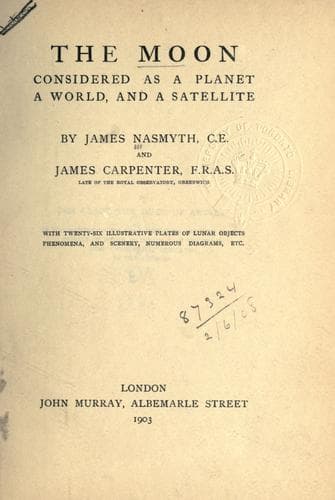
The Moon: considered as a planet, a world, and a satellite.Nasmyth, James
Science
The Moon: considered as a planet, a world, and a satellite.
Nasmyth, James
Moon
There are yet two other methods: one depending upon the phenomena of
nutation, or the attraction of the sun and moon upon the protruberant
matter of the terrestrial spheroid; and the other upon a displacement of
the centre of gravity of the earth and moon, which shows itself in
observations of the sun. By each and all of these methods has the lunar
mass been at various times determined, and it has been found, as the
latest and best accepted value, that the mass of the moon is
_one-eightieth_ that of the earth.
From the known diameter of the earth we ascertain that its volume is
259,360 millions of cubic miles: and from the various experiments that
have been made to determine the mean density of the earth, it has been
found that that mean density is about 5½ times that of water; that is to
say, the earth weighs 5½ times heavier than would a sphere of water of
equal size. Now a cubic foot of water weighs 62·3211 pounds, and from
this we can find by simple multiplication what is the weight of a cubic
mile of water, and, similarly, what would be the weight of 259,360 cubic
miles of water, and the last result multiplied by 5½ will give the
weight of the earth in tons: The calculation, although extremely simple,
involves a confusing heap of figures; but the result, which is all that
concerns us, is, that the weight of the earth is 5842 trillions of tons:
and since, as we have above stated, the mass of the earth is 80 times
that of the moon, it follows that the weight of the moon is 73 trillions
of tons.
The cubical contents of a body compared with its weight gives us its
density. In the moon we have 5276 millions of cubic miles of matter, the
total weight of which is 73 trillions of tons. Now, 5276 millions of
cubic miles of water would weigh about 21½ trillions of tons; and as
this number is to 73 as 1 is to 3·4, it is clear that the density of the
lunar matter is 3·4 greater than water: and inasmuch as the earth is 5½
times denser than water, we see that the moon is about 0·62 as dense as
the earth, or that the material of the moon is lighter, bulk for bulk,
than the mean material of the terraqueous globe in the proportion of 62
to 100, or, nearly, 6 to 10. This specific gravity of the lunar material
(3·4) we may remark is about the same as that of flint glass or the
diamond: and curiously enough it nearly coincides with that of some of
the aërolites that have from time to time fallen to the earth; hence
support has been claimed for the theory that these bodies were
originally fragments of lunar matter, probably ejected at some time from
the lunar volcanoes with such force as to propel them so far within the
sphere of the earth’s attraction that they have ultimately been drawn to
its surface.
Public-domain text, read in full here on John Shaqi.
Reviews
Reviews
No reviews yet
Be the first to share your thoughts on this work.
Join the Discussion
Join the discussion
Sign in to leave a comment or review.
Sign InorCreate an account