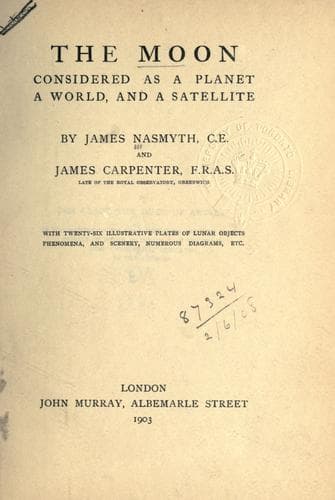
The Moon: considered as a planet, a world, and a satellite.Nasmyth, James
Science
The Moon: considered as a planet, a world, and a satellite.
Nasmyth, James
Moon
With the phenomena of the terrestrial atmosphere, with the effects that
are attributable to it, we are all well familiar, and our best course
therefore is to examine, as far as we are able, whether counterparts of
any of these effects are manifested upon the moon. For instance, the
clouds that are generated in and float through our air would, to an
observer on the moon, appear as ever changing bright or dusky spots,
obliterating certain of the permanent details of the earth’s surface,
and probably skirting the terrestrial disc, like the changing belts we
perceive on the planet Jupiter, or diversifying its features with less
regularity, after the manner exhibited by the planet Mars. If such
clouds existed on the moon it is evident that the details of its surface
must be, from time to time, similarly obscured; but no trace of such
obscuration has ever been detected. When the moon is observed with high
telescopic powers, all its details come out sharp and clear, without the
least appearance of change or the slightest symptoms of cloudiness other
than the occasional want of general definition, which may be proved to
be the result of unsteadiness or want of homogeneity in our own
atmosphere; for we must tell the uninitiated that nights of pure, good
definition, such as give the astronomer opportunity of examining with
high powers the minute details of planetary features, are very few and
far between. Out of the three hundred and sixty-five nights of a year
there are probably not a dozen that an astronomer can call really fine:
usually, even on nights that are to all common appearance superbly
brilliant, some strata of air of different densities or temperatures, or
in rapid motion, intervene between the observer and the object of his
observation, and through these, owing to the ever-changing refractions
which the rays of light coming from the object suffer in their course,
observation of the delicate markings of a planet is impossible: all is
blurred and confused, and nothing but bolder features can be recognized.
It has in consequence sometimes happened that a slight indistinctness of
some minute detail of the moon has been attributed to clouds or mists at
the lunar surface, whereas the real cause has been only a bad condition
of our own atmosphere. It may be confidently asserted that when all
indistinctness due to terrestrial causes is taken account of or
eliminated, there remain no traces whatever of any clouds or mists upon
the surface of the moon.
Public-domain text, read in full here on John Shaqi.
Reviews
Reviews
No reviews yet
Be the first to share your thoughts on this work.
Join the Discussion
Join the discussion
Sign in to leave a comment or review.
Sign InorCreate an account