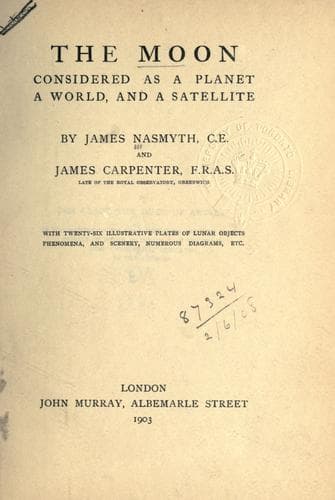
The Moon: considered as a planet, a world, and a satellite. — John Shaqi
The Moon: considered as a planet, a world, and a satellite.Nasmyth, James
Science
The Moon: considered as a planet, a world, and a satellite.
Nasmyth, James
Moon
It is the practice, in elementary and popular treatises on astronomy, to
state merely the numerical results in giving data such as those embodied
in the foregoing pages; and uninitiated readers, not knowing the means
by which the figures are arrived at, are sometimes disposed to regard
them with a certain amount of doubt or uncertainty. On this account we
have thought it advisable to give, in as brief and concise a form as
possible, the various steps by which these seemingly unattainable
results are obtained.
The data explained in the foregoing text are here collected to
facilitate reference.
Diameter of Moon 2160 miles 1/3·665 that of earth.
Area 14,657,000 square miles 1/13·424 ” ”
Area of the 7,328,500 square miles
visible
hemisphere
Solid contents 5276 millions of cubic miles 1/49·186 ” ”
Mass 73 trillions of tons 1/80 ” ”
Density 3·39 (water = 1) 0·62 ” ”
Force of 1/6 ” ”
gravity at
surface
Mean distance 238,790 miles.
from earth
CHAPTER V.
ON THE EXISTENCE OR NON-EXISTENCE OF A LUNAR ATMOSPHERE.
At the close of the preceding chapter we stated that any force acting in
opposition to that of gravity would be six times more effective on the
moon than on the earth. But, in fact, it would in many cases be still
more so; at all events, so far as projectile forces are concerned; for
the reason that “the powerful coercer of projectile range,” as the
earth’s atmosphere has been termed, has no counterpart, or at most a
very disproportionate one, upon the moon.
The existence of an atmosphere surrounding the moon has been the subject
of considerable controversy, and a great deal of evidence on both sides
of the question has been offered from time to time, and is to be found
scattered through the records of various classes of observations. Some
of the more important items of this evidence it is our purpose to set
forth in the course of the present chapter.
Public-domain text, read in full here on John Shaqi.
Reviews
Reviews
No reviews yet
Be the first to share your thoughts on this work.
Join the Discussion
Join the discussion
Sign in to leave a comment or review.
Sign InorCreate an account