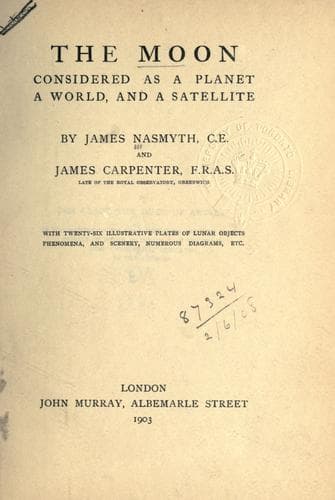
The Moon: considered as a planet, a world, and a satellite.Nasmyth, James
Science
The Moon: considered as a planet, a world, and a satellite.
Nasmyth, James
Moon
experiment for those to try who pursue that branch of astronomical
observation.
A merely cursory examination of the moon with the low power to which we
have alluded is sufficient to show us the more salient features. In the
first place we cannot help being struck with the immense preponderance
of circular or craterform asperities, and with the general tendency to
circular shape which is apparent in nearly all the lunar surface
markings; for even the larger regions known as the “seas” and the
smaller patches of the same character seem to repeat in their outlines
the round form of the craters. It is at the boundary of sunlight on the
lunar globe that we see these craterform spots to the best advantage, as
it is there that the rising or setting sun casts long shadows over the
lunar landscape, and brings elevations and asperities into bold relief.
They vary greatly in size, some are so large as to bear an estimable
proportion to the moon’s diameter, and the smallest are so minute as to
need the most powerful telescopes and the finest conditions of
atmosphere to perceive them. It is doubtful whether the smallest of them
have ever been seen, for there is no reason to doubt that there exist
countless numbers that are beyond the revealing powers of our finest
telescopes.
From the great number and persistent character of these
circumvallations, Kepler was led to think that they were of artificial
construction. He regarded them as pits excavated by the supposed
habitants of the moon to shelter themselves from the long and intense
action of the sun. Had he known their real dimensions, of which we shall
have to speak when we come to describe them more in detail, he would
have hesitated in propounding such a hypothesis; nevertheless it was, to
a certain extent, justified by the regular and seemingly unnatural
recurrence of one particular form of structure, the like of which is,
too, so seldom met with as a structural feature of the surface of our
own globe.
Public-domain text, read in full here on John Shaqi.
Reviews
Reviews
No reviews yet
Be the first to share your thoughts on this work.
Elsewhere in the archive
Join the Discussion
Join the discussion
Sign in to leave a comment or review.
Sign InorCreate an account