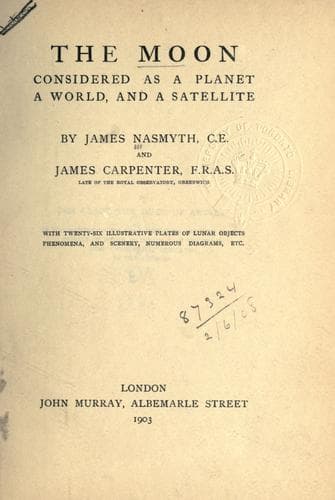
The Moon: considered as a planet, a world, and a satellite.Nasmyth, James
Science
The Moon: considered as a planet, a world, and a satellite.
Nasmyth, James
Moon
The next most striking features, revealed by a low telescopic power upon
the moon, are the seemingly smooth plains that have the appearance of
dusky spots, and that collectively cover a considerable portion—about
two-thirds—of the entire disc. The larger of these spots retain the name
of _seas_, the term having been given when they were supposed to be
watery expanses, and having been retained, possibly to avoid the
confusion inevitable from a change of name, after the existence of water
upon the moon was disproved. Following the same order of nomenclature,
the smaller spots have received the appellations of _lakes_, _bays_ and
_fens_. We see that many of these “seas” are partially surrounded by
ramparts or bulwarks which, under closer examination, and having regard
to their real magnitude, resolve themselves into immense mountain
chains. The general resemblance in form which the bulwarked plains thus
exhibit to the circular craters of large size, would lead us to suppose
that the two classes of objects had the same formative origin, but when
we take into account the immense size of the former, and the process by
which we infer the latter to have been developed, the supposition
becomes untenable.
Another of the prominent features which we notice as highly curious, and
in some phases of the moon—at about the time of full—the most remarkable
of all, are certain bright lines that appear to radiate from some of the
more conspicuous craters, and extend for hundreds of miles around. No
selenological formations have so sorely puzzled observers as these
peculiar streaks, and a great deal of fanciful theorizing has been
bestowed upon them. As we are now only glancing at the moon, we do not
enter upon explanations concerning them or any other class of details;
all such will receive due consideration in their proper order in
succeeding chapters.
Public-domain text, read in full here on John Shaqi.
Reviews
Reviews
No reviews yet
Be the first to share your thoughts on this work.
Elsewhere in the archive
Join the Discussion
Join the discussion
Sign in to leave a comment or review.
Sign InorCreate an account