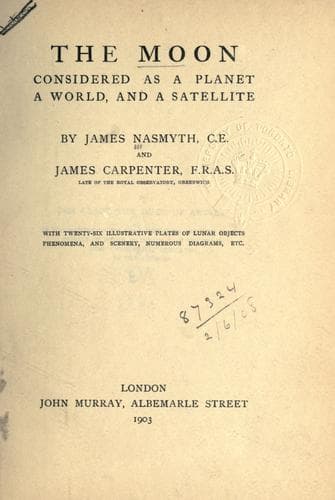
The Moon: considered as a planet, a world, and a satellite.Nasmyth, James
Science
The Moon: considered as a planet, a world, and a satellite.
Nasmyth, James
Moon
We thus see that the classes of features observable upon the moon are
not great in number: they may be summed up as _craters_ and their
central cones, _mountain chains_, with occasional isolated peaks,
_smooth plains_, with more or less of irregularity of surface, and
_bright radiating streaks_. But when we come to study with higher powers
the individual examples of each class we meet with considerable
diversity. This is especially the case with the craters, which appear
under very numerous variations of the one order of structure, viz., the
ring-form. A higher telescopic power shows us that not only do these
craters exist of all magnitudes within a limit of largeness, but
seemingly with no limit of smallness, but that in their structure and
arrangement they present a great variety of points of difference. Some
are seen to be considerably elevated above the surrounding surface,
others are basins hollowed out of that surface and with low surrounding
ramparts; some are merely like walled plains or amphitheatres with flat
plateaux, while the majority have their lowest point of hollowness
considerably below the general level of the surrounding surface; some
are isolated upon the plains, others are aggregated into a thick crowd,
and overlapping and intruding upon each other; some have elevated peaks
or cones in their centres, and some are without these central cones,
while the plateaux of others again contain several minute craters
instead; some have their ramparts whole and perfect, others have them
breached or malformed, and many have them divided into terraces,
especially on their inner sides.
In the plains, what with a low power appeared smooth as a water surface
becomes, under greater magnification, a rough and furrowed area, here
gently undulated and there broken into ridges and declivities, with now
and then deep rents or cracks extending for miles and spreading like
river-beds into numerous ramifications. Craters of all sizes and classes
are scattered over the plains; these appear generally of a different
tint to the surrounding surface, for the light reflected from the plains
has been observed to be slightly tinged with colour, The tint is not the
same in all cases: one large sea has a dingy greenish tinge, others are
merely grey and some others present a pale reddish hue. The cause of
this diversity of colour is mysterious; it has been supposed to indicate
the existence of vegetation of some sort; but this involves conditions
that we know do not exist.
Public-domain text, read in full here on John Shaqi.
Reviews
Reviews
No reviews yet
Be the first to share your thoughts on this work.
Elsewhere in the archive
Join the Discussion
Join the discussion
Sign in to leave a comment or review.
Sign InorCreate an account