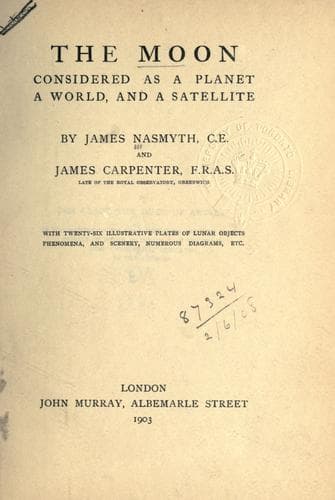
The Moon: considered as a planet, a world, and a satellite.Nasmyth, James
Science
The Moon: considered as a planet, a world, and a satellite.
Nasmyth, James
Moon
The mountains, under higher magnification, do not present such diversity
of formation as the craters, or at least the points of difference are
not so apparent; but they exhibit a plentiful variety of combinations.
There are a few perfectly isolated examples that cast long shadows over
the plains on which they stand like those of a towering cathedral in the
rising or setting sun. Sometimes they are collected into groups, but
mostly they are connected into stupendous chains. In one of the grandest
of these chains, it has been estimated that a good telescope will show
3000 mountains clustered together, without approach to symmetrical
order. The scenery which they would present, could we get any other than
the “bird’s eye view” to which we are confined, must be imposing in the
extreme, far exceeding in sublime grandeur anything that the Alps or the
Himalayas offer; for while on the one hand the lunar mountains equal
those of the earth in altitude, the absence of an atmosphere, and
consequently of the effects produced thereby, must give rise to
alternations of dazzling light and black depths of shade combining to
form panoramas of wild scenery that, for want of a parallel on earth, we
may well call unearthly. But we are debarred the pleasure of actually
contemplating such pictures by the circumstance that we look _down_ upon
the mountain tops and into the valleys, so that the great height and
close aggregation of the peaks and hills are not so apparent. To compare
the lunar and terrestrial mountain scenery would be “to compare the
different views of a town seen from the car of a balloon, with the more
interesting prospects by a progress through the streets.” Some of the
peculiarities of the lunar scenery we have, however, endeavoured to
realize in a subsequent Chapter.
Public-domain text, read in full here on John Shaqi.
Reviews
Reviews
No reviews yet
Be the first to share your thoughts on this work.
Elsewhere in the archive
Join the Discussion
Join the discussion
Sign in to leave a comment or review.
Sign InorCreate an account