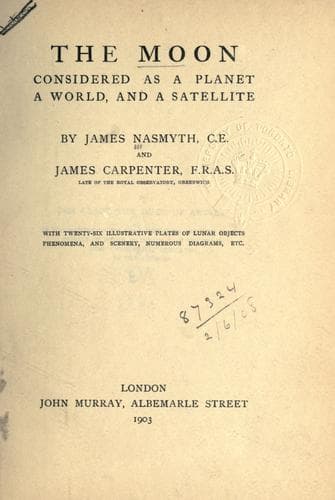
The Moon: considered as a planet, a world, and a satellite.Nasmyth, James
Science
The Moon: considered as a planet, a world, and a satellite.
Nasmyth, James
Moon
A high power gives us little more evidence than a low one upon the
nature of the long bright streaks that radiate from some of the more
conspicuous craters, but it enables us to see that those streaks do not
arise from any perceptible difference of level of the surface—that they
have no very definite outline, and that they do not present any sloping
sides to catch more sunlight, and thus shine brighter, than the general
surface. Indeed, one great peculiarity of them is that they come out
most forcibly where the sun is shining perpendicularly upon them; hence
they are best seen where the moon is at full, and they are not visible
at all at those regions upon which the sun is rising or setting. We also
see that they are not diverted by elevations in their path, as they
traverse in their course craters, mountains, and plains alike, giving a
slight additional brightness to all objects over which they pass, but
producing no other effect upon them. To employ a commonplace simile,
they look as though, after the whole surface of the moon had assumed its
final configuration, a vast brush charged with a whitish pigment had
been drawn over the globe in straight lines radiating from a central
point, leaving its trail upon everything it touched, but obscuring
nothing.
Whatever may be the cause that produces this brightness of certain parts
of the moon without reference to configuration of surface, this cause
has not been confined to the formation of the radiating lines, for we
meet with many isolated spots, streaks and patches of the same bright
character. Upon some of the plains there are small areas and lines of
luminous matter possessing peculiarities similar to those of the
radiating streaks, as regards visibility with the high sun, and
invisibility when the solar rays fall upon them horizontally. Some of
the craters also are surrounded by a kind of aureole of this highly
reflective matter. A notable specimen is that called _Linné_, concerning
which a great hue and cry about change of appearance and inferred
continuance of volcanic action on the moon was raised some years ago.
This object is an insignificant little crater of about a mile or two in
diameter, in the centre of an ill-defined spot of the character referred
to, and about eight or ten miles in diameter. With a low sun the crater
alone is visible by its shadow; but as the luminary rises the shadow
shortens and becomes all but invisible, and then the white spot shines
forth. These alternations, complicated by variations of atmospheric
condition, and by the interpretations of different observers, gave rise
to statements of somewhat exaggerated character to the effect that
considerable changes, of the nature of volcanic eruptions, were in
progress in that particular region of the moon.
Public-domain text, read in full here on John Shaqi.
Reviews
Reviews
No reviews yet
Be the first to share your thoughts on this work.
Elsewhere in the archive
Join the Discussion
Join the discussion
Sign in to leave a comment or review.
Sign InorCreate an account