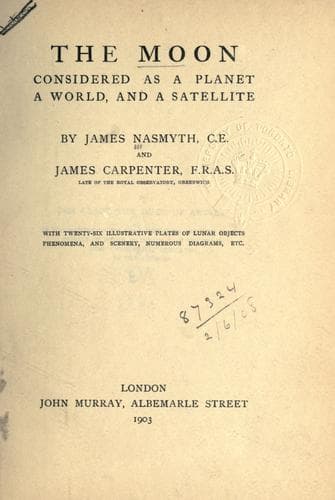
The Moon: considered as a planet, a world, and a satellite.Nasmyth, James
Science
The Moon: considered as a planet, a world, and a satellite.
Nasmyth, James
Moon
In the foregoing remarks we have alluded somewhat indefinitely to high
powers; and an enquiring but unastronomical reader may reasonably demand
some information upon this point. It might have been instructive to have
cited the various details that may be said to come into view with
progressive increases of magnification. But this would be an all but
impossible task, on account of the varying conditions under which all
astronomical observations must necessarily be made. When we come to
delicate tests, there are no standards of telescopic power and
definition. Assuming the instrument to be of good size and high optical
character, there is yet a powerful influant of astronomical definition
in the atmosphere and its variable state. Upon two-thirds of the clear
nights of a year the finest telescopes cannot be used to their full
advantage, because the minute flutterings resulting from the passage of
the rays of light through moving strata of air of different densities
are magnified just as the image in the telescope is magnified, till all
minute details are blurred and confused, and only the grosser features
are left visible. And supposing the telescope and atmosphere in good
state, there is still an important point, the state of the observer’s
eye, to be considered. After all it is the eye that sees, and the best
telescopic assistance to an untrained eye is of small avail. The eye is
as susceptible of education and development as any other organ; a
skilful and acute observer is to a mere casual gazer, what a watchmaker
would be to a ploughman, a miniature painter to a whitewasher. This fact
is not generally recognized; no man would think of taking in hand an
engraver’s burin, and expecting on the instant to use it like an adept,
or of going to a smithy and without previous preparation trying to forge
a horse-shoe. Yet do folks enter observatories with uneducated eyes, and
expect at once to realize all the wonderful things that their minds have
pictured to themselves from the perusal of astronomical books. We have
over and over again remarked the dissatisfaction which attends the first
looks of novices through a powerful telescope. They anticipate
immediately beholding wonders, and they are disappointed at finding how
little they can see, and how far short the sight falls of what they had
expected. Courtesy at times leads them to express wonder and surprise,
which it is easy to see is not really felt, but sometimes honesty
compels them to give expression to their disappointment. This arises
from the simple fact that their eyes are not fit for the work which is
for the moment imposed upon them; they know not what to look for, or how
to look for it. The first essay at telescopic gazing, like first essays
generally, serves but to teach us our incapability.
Public-domain text, read in full here on John Shaqi.
Reviews
Reviews
No reviews yet
Be the first to share your thoughts on this work.
Elsewhere in the archive
Join the Discussion
Join the discussion
Sign in to leave a comment or review.
Sign InorCreate an account