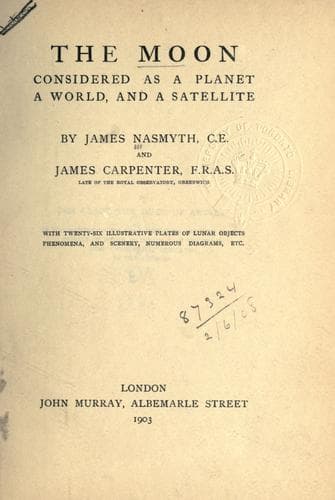
The Moon: considered as a planet, a world, and a satellite.Nasmyth, James
Science
The Moon: considered as a planet, a world, and a satellite.
Nasmyth, James
Moon
To a tutored eye a great deal is visible with a comparatively low power,
and practised observers strive to use magnifying powers as low as
possible, so as to diminish, as far as may be, the evils arising from an
untranquil atmosphere. With a power so small as 30 or 40, many
exceedingly delicate details on the moon are visible to an eye that is
familiar with them under higher powers. With 200 we may say that every
ordinary detail will come out under favourable conditions; but when
minute points of structure, mere nooks and corners as it were, are to be
scrutinised, 300 may be used with advantage. Another hundred diameters
almost passes the practical limit. Unless the air be not merely fine,
but superfine, the details become “clothy” and tremulous; the extra
points brought out by the increased power are then only caught by
momentary glimpses, of which but a very few are obtained during a
lengthy period of persistent scrutiny. We may set down 250 as the most
useful, and 350 the utmost effective power that can be employed upon the
particular work of which we are treating. Could every detail on the moon
be thoroughly and reliably represented as this amount of magnification
shows it, the result would leave little to be wished for.
But it may be asked by some, what is the absolute effect of such powers
as those we have spoken of, in bringing the moon apparently nearer to
our eyes? and what is the actual size of the smallest object visible
under the most favourable circumstances? A linear mile upon the moon
corresponds to an angular interval of 0·87 of a second; this refers to
regions about the centre of the disc; near the circumference the
foreshortening makes a difference, very great as the edge is approached.
Perhaps the smallest angle that the eye can without assistance
appreciate is half a minute; that is to say, an object that subtends to
the eye an arc of less than a half a minute can scarcely be seen.[7]
Since there are 60 seconds in a minute, it follows that we must magnify
a spot a second in diameter upon the moon thirty times before we can see
it; and since a second represents rather more than a mile, really about
2000 yards, on the moon, as seen from the earth, the smallest object
visible with a power of 30 will be this number of yards in diameter or
breadth. To see an object 200 yards across, we should require to magnify
it 300 times, and this would only bring it into view as a point; 20
yards would require a power of 3000, and 1 yard 60,000 to effect the
same thing. Since, as we have said, the highest practicable power with
our present telescopes, and at ordinary terrestrial elevations, is 350,
or for an extreme say 400, it is evident that the minutest lunar object
or detail of which we can perceive as a point must measure about 150
yards: to see the form of an object, so as to discriminate whether it be
round or square, it would require to be probably twice this size; for it
Public-domain text, read in full here on John Shaqi.
Reviews
Reviews
No reviews yet
Be the first to share your thoughts on this work.
Elsewhere in the archive
Join the Discussion
Join the discussion
Sign in to leave a comment or review.
Sign InorCreate an account