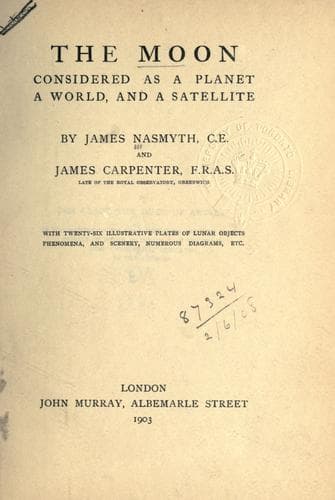
The Moon: considered as a planet, a world, and a satellite.Nasmyth, James
Science
The Moon: considered as a planet, a world, and a satellite.
Nasmyth, James
Moon
PLATE PAGE
Gassendi _Frontispiece_
I.—Summit of Vesuvius 26
II.—Wrinkled Hand and Apple 30
III.—Full Moon Photograph 52
IV.—Picture-Map of the Moon {_To face each other._}
V.—Skeleton Map 68
VI.—Terrestrial and Lunar Volcanic Areas Compared 88
VII.—Progressive Series of Craters 92
VIII.—Copernicus 96
IX.—The Lunar Apennines, &c., &c. 100
X.—Aristotle and Eudoxus 104
XI.—Triesnecker 108
XII.—Theophilus, Cyrillus, and Catharina 112
XIII.—Arzachael, Ptolemy, and the Railway 116
XIV.—Plato, the Valley of the Alps, Pico, &c. 120
XV.—Mercator and Campanus 124
XVI.—Tycho and its Surroundings 128
XVII.—Wargentin 132
XVIII.—Aristarchus and Herodotus 136
XIX.—Glass Globe Cracked by Internal Pressure 140
XX.—Overlapping Craters 148
XXI.—Lunar Crater. Ideal Landscape 156
XXII.—Solar Eclipse as it would be seen from the Moon 164
XXIII.—Group of Mountains. Ideal Lunar Landscape 170
THE MOON.
CHAPTER I.
ON THE COSMICAL ORIGIN OF THE PLANETS OF THE SOLAR SYSTEM.
In this Chapter we propose to treat briefly of the probable formation of
the various members of the solar system from matter which previously
existed in space in a condition different from that in which we at
present find it—_i.e._, in the form of planets and satellites.
Public-domain text, read in full here on John Shaqi.
Reviews
Reviews
No reviews yet
Be the first to share your thoughts on this work.
Join the Discussion
Join the discussion
Sign in to leave a comment or review.
Sign InorCreate an account