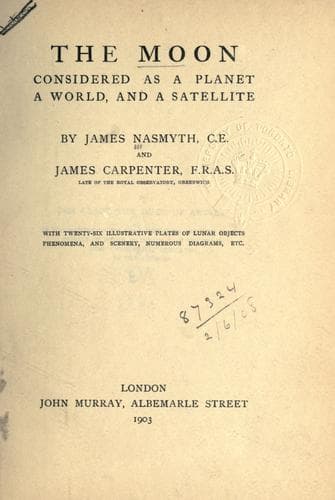
The Moon: considered as a planet, a world, and a satellite.Nasmyth, James
Science
The Moon: considered as a planet, a world, and a satellite.
Nasmyth, James
Moon
It is almost impossible to conceive that our world with its satellite,
and its fellow worlds with their satellites, and also the great centre
of them all, have always, from the commencement of time, possessed their
present form: all our experiences of the working of natural laws rebel
against such a supposition. In every phenomenon of nature upon this
earth—the great field from which we must glean our experiences and form
our analogies—we see a constant succession of changes going on, a
constant progression from one stage of development to another taking
place, a perpetual mutation of form and nature of the same material
substance occurring: we see the seed transformed into the plant, the
flower into the fruit, and the ovum into the animal. In the inorganic
world we witness the operation of the same principle; but, by reason of
their slower rate of progression, the changes there are manifested to us
rather by their resulting effects than by their visible course of
operation. And when we consider, as we are obliged to do, that the same
laws work in the greatest as well as the smallest processes of nature,
we are compelled to believe in an antecedent state of existence of the
matter that composes the host of heavenly bodies, and amongst them the
earth and its attendant moon.
In the pursuit of this course of argument we are led to inquire whether
there exists in the universe any matter from which planetary bodies
could be formed, and how far their formation from such matter can be
explained by the operation of known material laws.
Public-domain text, read in full here on John Shaqi.
Reviews
Reviews
No reviews yet
Be the first to share your thoughts on this work.
Join the Discussion
Join the discussion
Sign in to leave a comment or review.
Sign InorCreate an account