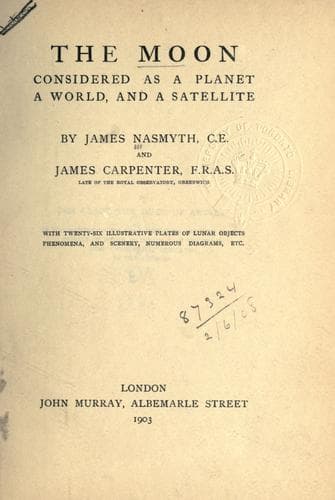
The Moon: considered as a planet, a world, and a satellite.Nasmyth, James
Science
The Moon: considered as a planet, a world, and a satellite.
Nasmyth, James
Moon
These two fine examples of lunar volcanic craters are conspicuously
situated in the north-east quarter of the moon’s disc. Aristarchus has a
circular rampart nearly 28 miles diameter, the summit of which is about
7500 feet above the surface of the plateau, while its height above the
general surface of the moon is 2600 feet. A central cone having several
subordinate peaks completes the true volcanic character of this crater:
its rampart banks, both outside and inside, have fine examples of the
segmental crescent-shaped ridges or landslips, which form so constant
and characteristic a feature in the structure of lunar craters. Several
very notable cracks or chasms may be seen to the north of these two
craters. They are contorted in a very unusual and remarkable manner, the
result probably of the force which formed them having to encounter very
varying resistance near the surface.
Some parts of these chasms gape to the width of two to three miles, and
when closely scrutinized are seen to be here and there partly filled by
masses which have fallen inward from their sides. Several smaller
craters are scattered around, which, together with the great chasms and
neighbouring ridges, give evidence of varied volcanic activity in this
locality. We must not omit to draw attention to the parallelism or
general similarity of “strike” in the ridges of extruded matter; this
appearance has special interest in the eyes of geologists, and is well
represented in our illustration.
Aristarchus is specially remarkable for the extraordinary capability
which the material forming its interior and rampart banks has of
reflecting light. Although there are many portions of the lunar surface
which possess the same property, yet few so remarkably as in the case of
Aristarchus, which shines with such brightness, as compared with its
immediate surroundings, as to attract the attention of the most
unpractized observer. Some have supposed this appearance to be due to
active volcanic discharge still lingering on the lunar surface, an idea
in which, for reasons to be duly adduced, we have no faith. Copernicus,
in the remarkable bright streaks which radiate from it, and Tycho also,
as well as several other spots, are apparently composed of material very
nearly as highly reflective as that of Aristarchus. But the comparative
isolation of Aristarchus, as well as the extraordinary light-reflecting
property of its material, renders it especially noticeable, so much so
as to make it quite a conspicuous object when illuminated only by
earth-light, when but a slender crescent of the lunar disc is
illuminated, or when, as during a lunar eclipse, the disc of the moon is
within the shadow of the earth, and is lighted only by the rays
refracted through the earth’s atmosphere.
Public-domain text, read in full here on John Shaqi.
Reviews
Reviews
No reviews yet
Be the first to share your thoughts on this work.
Elsewhere in the archive
Join the Discussion
Join the discussion
Sign in to leave a comment or review.
Sign InorCreate an account