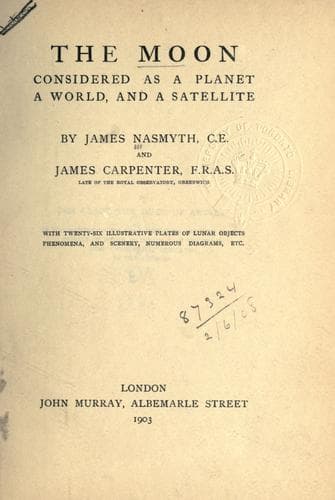
The Moon: considered as a planet, a world, and a satellite.Nasmyth, James
Science
The Moon: considered as a planet, a world, and a satellite.
Nasmyth, James
Moon
We can scarcely doubt that where a lunar crater bears general
resemblance to a terrestrial crater, the process of formation has been
nearly the same in the one case as in the other. Where variations
present themselves they may reasonably be ascribed to the difference of
conditions pertaining to the two spheres. The greatest dissimilarity is
in the point of dimensions; the projection of materials to 20 or more
miles distance from a volcanic vent appears almost incredible, until we
realize the full effect of the conditions which upon the moon are so
favourable to the dispersive action of an eruptive force. In the first
place, the force of gravity upon our satellite is only one-sixth of that
to which bodies are subject upon the earth. Secondly, by reason of the
small magnitude of the moon and its proportionally much larger surface
in ratio to its magnitude, the rate at which it parted with its cosmical
heat must have been much more rapid than in the case of the earth,
especially when enhanced by the absence of the heat-conserving power of
an atmosphere of air or water vapour; and the disruptive and eruptive
action and energy may be assumed to be greater in proportion to the more
rapid rate of cooling; operating, too, as eruptive action would on
matter so much reduced in weight as it is on the surface of the moon, we
thus find in combination conditions most favourable to the display of
volcanic action in the highest degree of violence. Moreover, as the
ejected material in its passage from the centre of discharge had not to
encounter any atmospheric resistance, it was left free to continue the
primary impulse of its ejection without other than gravitative
diminution, and thus to deposit itself at distances from its source
vastly greater than those of which we have examples on the earth.
Public-domain text, read in full here on John Shaqi.
Reviews
Reviews
No reviews yet
Be the first to share your thoughts on this work.
Elsewhere in the archive
Join the Discussion
Join the discussion
Sign in to leave a comment or review.
Sign InorCreate an account