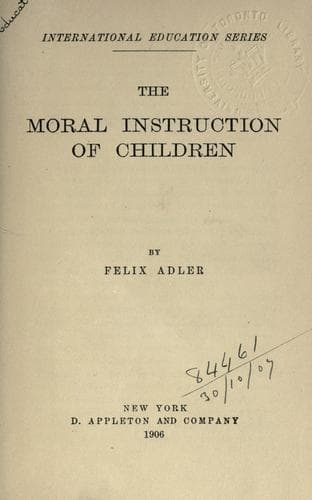
Moral education is everywhere acknowledged to be the most important part
of all education; but there has not been the same agreement in regard to
the best means of securing it in the school. This has been due in part
to a want of insight into the twofold nature of this sort of education;
for instruction in morals includes two things: the formation of right
ideas and the formation of right habits. Right ideas are necessary to
guide the will, but right habits are the product of the will itself.
It is possible to have right ideas to some extent without the
corresponding moral habits. On this account the formation of correct
habits has been esteemed by some to be the chief thing. But unconscious
habits--mere use and wont--do not seem to deserve the title of moral in
its highest sense. The moral act should be a considerate one, and rest
on the adoption of principles to guide one's actions.
To those who lay stress on the practical side and demand the formation
of correct habits, the school as it is seems to be a great ethical
instrumentality. To those who see in theoretical instruction the only
true basis of moral character, the existing school methods seem sadly
deficient.
The school as it is looks first after its discipline, and next after its
instruction. Discipline concerns the behavior, and instruction concerns
the intellectual progress of the pupil. That part of moral education
which relates to habits of good behavior is much better provided for in
the school than any part of intellectual education.
There is, however, a conflict here between old and new ideals. The
old-fashioned school regarded obedience to authority the one essential;
the new ideal regards insight into the reasonableness of moral commands
the chief end. It is said, with truth, that a habit of unreasoning
obedience does not fit one for the exigencies of modern life, with its
partisan appeals to the individual and its perpetual display of grounds
and reasons, specious and otherwise, in the newspapers. The unreasoning
obedience to a moral guide in school may become in after life
unreasoning obedience to a demagogue or to a leader in crime.
It is not obedience to external authority that we need so much as
enlightened moral sense, and yet there remains and will remain much good
in the old-fashioned habit of implicit obedience.
Public-domain text, read in full here on John Shaqi.
Reviews
Reviews
No reviews yet
Be the first to share your thoughts on this work.
Join the Discussion
Join the discussion
Sign in to leave a comment or review.
Sign InorCreate an account