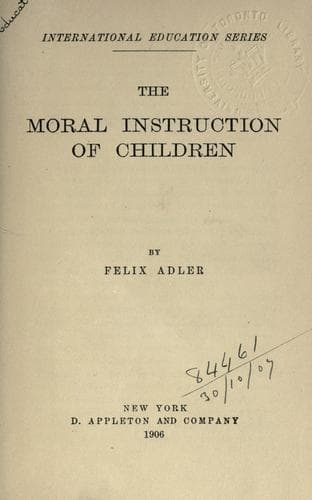
The new education aims at building up self-control and individual
insight. It substitutes the internal authority of conscience for the
external authority of the master. It claims by this to educate the
citizen fitted for the exercise of suffrage in a free government. He
will weigh political and social questions in his mind, and decide for
himself. He will be apt to reject the scheme of the demagogue. While the
old-fashioned school-master relied on the rod to sustain his external
authority, he produced, it is said, a reaction against all authority in
the minds of strong-willed pupils. The new education saves the
strong-willed pupil from this tension against constituted authority, and
makes him law-abiding from the beginning.
It will be admitted that the school under both its forms--old as well as
new--secures in the main the formation of the cardinal moral habits. It
is obliged to insist on regularity, punctuality, silence, and industry
as indispensable for the performance of its school tasks. A private
tutor may permit his charge to neglect all these things, and yet secure
some progress in studies carried on by fits and starts, with noise and
zeal to-day, followed by indolence to-morrow. But a school, on account
of its numbers, must insist on the semi-mechanical virtues of
regularity, punctuality, silence, and industry. Although these are
semi-mechanical in their nature, for with much practice they become
unconscious habits, yet they furnish the very ground-work of all
combinations of man with his fellow-men. They are fundamental conditions
of social life. The increase of city population, consequent on the
growth of productive industry and the substitution of machines for hand
labor, renders necessary the universal prevalence of these cardinal
virtues of the school.
Even the management of machines requires that sort of alertness which
comes from regularity and punctuality. The travel on the railroad, the
management of steam-engines, the necessities of concerted action,
require punctuality and rhythmic action.
The school habit of silence means considerate regard for the rights of
fellow-workmen. They must not be interfered with; their attention must
not be distracted from their several tasks. A rational self-restraint
grows out of this school habit--rational, because it rests on
considerateness for the work of others. This is a great lesson in
co-operation. Morals in their essence deal with the relation of man to
his fellow-men, and rest on a considerateness for the rights of others.
"Do unto others," etc., sums up the moral code.
Public-domain text, read in full here on John Shaqi.
Reviews
Reviews
No reviews yet
Be the first to share your thoughts on this work.
Join the Discussion
Join the discussion
Sign in to leave a comment or review.
Sign InorCreate an account