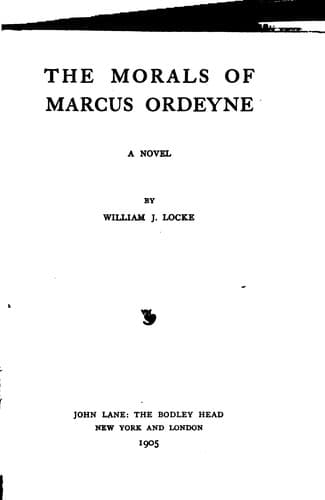
The Morals of Marcus Ordeyne : a NovelLocke, William John
Philosophy
The Morals of Marcus Ordeyne : a Novel
Locke, William John
Guardian and ward -- Fiction; Inheritance and succession -- Fiction; Scholars -- Fiction
I lit another cigarette. “I think the sex feminine has marriage on the
brain,” I exclaimed, somewhat heatedly. “My Aunt Jessica was worrying me
about it the day before yesterday. As if it were any concern of hers!”
Judith laughed below her breath and called me a simpleton.
“Why?” I asked.
“Because you haven’t got a temperament.”
This was a foolish answer, having no bearing on the question. I told
her so. She replied that she was years older than I, and had learned
the eternal relevance of all things. I pointed out that she was years
younger.
“How many heart-beats have you had in your life--real, wild, pulsating
heart-beats--eternity in an hour?”
“That’s Blake,” I murmured.
“I’m aware of it. Answer my question.”
“It’s a silly question.”
“It isn’t. The next time you see a female baby in a perambulator, take
off your hat respectfully.”
I am afraid I am clumsy at repartee.
“And the next time you engage a cook, my dear Judith,” said I, “send for
a mere man.”
She coloured up. I dissolved myself in apologies. Her wounded
susceptibilities required careful healing. The situation was somewhat
odd. She had not scrupled to attack the innermost weaknesses of my
character, and yet when I retaliated by a hit at externals, she was
deeply hurt, and made me feel a ruffianly blackguard. I really think if
Lisette had pinned up that curtain I should have learned something more
about female human nature. But Judith is the only woman I have known
intimately all my life long, and sometimes I wonder whether I shall ever
know her. I told her so once. She answered: “If you loved me you would
know me.” Very likely she was right. Honestly speaking, I don’t love
Judith. I am accustomed to her. She is a lady, born and bred. She is
an educated woman and takes quite an intelligent interest in the
Renaissance. Indeed she has a subtler appreciation of the Venetian
School of Painting than I have. She first opened my eyes, in Italy, to
the beauties, as a gorgeous colourist, of Palma Vecchio in his second or
Giorgionesque manner. She is in every way a sympathetic and entertaining
companion. Going deeper, to the roots of human instinct, I find she
represents to me--so chance has willed it--the _ewige weibliche_ which
must complement masculinity in order to produce normal existence. But as
for the “_zieht uns hinan_”--no. It would not attract me hence--out of
my sphere. I could commit an immortal folly for no woman who ever made
this planet more lustrous to its Bruderspharen.
Public-domain text, read in full here on John Shaqi.
Reviews
Reviews
No reviews yet
Be the first to share your thoughts on this work.
Join the Discussion
Join the discussion
Sign in to leave a comment or review.
Sign InorCreate an account