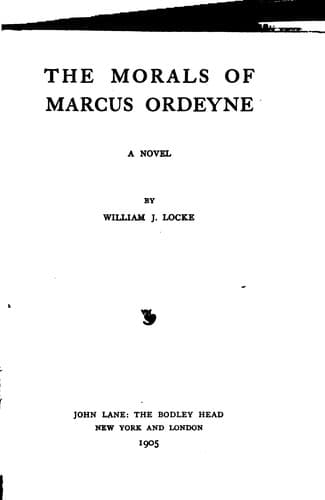
The Morals of Marcus Ordeyne : a Novel — John Shaqi
The Morals of Marcus Ordeyne : a NovelLocke, William John
Philosophy
The Morals of Marcus Ordeyne : a Novel
Locke, William John
Guardian and ward -- Fiction; Inheritance and succession -- Fiction; Scholars -- Fiction
I don’t understand Judith. It doesn’t very greatly matter. Many things
I don’t understand, the spiritual attitude towards himself, for example,
of the intelligent juggler who expends his life’s energies in balancing
a cue and three billiard-balls on the tip of his nose. But I know that
Judith understands me, and therein lies the advantage I gain from our
intimacy. She gauges, to an absurdly subtle degree, the depth of my
affection. She is really an incomparable woman. So many insist upon
predilection masquerading as consuming passion. There is nothing
theatrical about Judith.
Yet to-day she appeared a little touchy, moody, unsettled. She broke
another pleasant spell of fireside silence, that followed expiation of
my offence, by suddenly calling my name.
“Yes?” said I, inquiringly.
“I want to tell you something. Please promise me you won’t be vexed.”
“My dear Judith,” said I, “my great and imperial namesake, in whose
meditations I have always found ineffable comfort, tells me this: ‘If
anything external vexes you, take notice that it is not the thing which
disturbs you, but your notion about it, which notion you may dismiss
at once, if you please!’ So I promise to dismiss all my notions of your
disturbing communication and not to be vexed.”
“If there is one platitudinist I dislike more than another, it is Marcus
Aurelius,” said Judith.
I laughed. It was very comfortable to sit before the fire, which
protested, in a fire’s cheery, human way, against the depression of the
murky world outside, and to banter Judith.
“I can quite understand it,” I said. “A man sucks in the consolations of
philosophy; a woman solaces herself with religion.”
“I can do neither,” she replied, changing her attitude with an
exaggerated shaking down of skirts. “If I could, I shouldn’t want to go
away.”
“Go away?” I echud.
“Yes. You mustn’t be vexed with me. I haven’t got a cook--”
“No one would have thought it, from the luncheon you gave me, my dear.”
The alcoholized domestic, by the way, was sent out, bag and baggage,
last evening, when she was sober enough to walk.
“And so it is a convenient opportunity,” Judith continued, ignoring my
compliment--and rightly so; for as soon as it had been uttered, I was
struck by an uneasy conviction that she had herself disturbed the French
caterers in the Tottenham Court Road from their Sabbath repose in order
to provide me with food.
“I can shut up the flat without any fuss. I am never happy at the
beginning of a London season. I know I’m silly,” she went on, hurriedly.
“If I could stand your dreadful Marcus Aurelius I might be wiser--I
don’t mind the rest of the year; but in the season everybody is in
town--people I used to know and mix with--I meet them in the streets
and they cut me and it--hurts--and so I want to get away somewhere by
myself. When I get sick of solitude I’ll come back.”
One of her quick, graceful movements brought her to her knees by my
side. She caught my hand.
Public-domain text, read in full here on John Shaqi.
Reviews
Reviews
No reviews yet
Be the first to share your thoughts on this work.
Join the Discussion
Join the discussion
Sign in to leave a comment or review.
Sign InorCreate an account