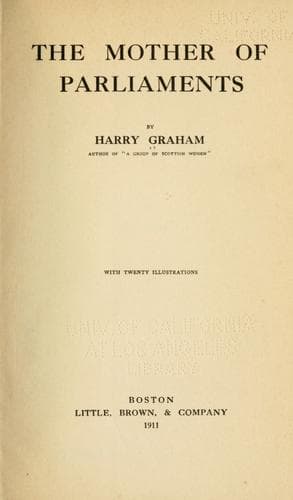
Great Britain. Parliament; Great Britain. Parliament -- History; Representative government and representation
The Resolutions recently passed by the Commons,[51] have for their
object the complete annihilation of the latter in all matters of
finance, and the retention for them of such modified powers of
influencing other legislation as would enable them to delay Bills
during the early years of a shortened Parliament, and refer them to
the country during its last two years. The question of "tacking," in
Money Bills, is to be referred to the sole arbitrament of the Speaker;
but this becomes of trifling importance when it is argued that almost
any revolutionary change could be effected within the corners of a
legitimate financial measure. The objection taken to the overriding of
the Veto in the case of a Bill thrice presented, is that it amounts to
one-Chamber legislation and would result in two classes of Acts--one
passed by the Commons alone, and the other by both Houses.
[51] "1. That it is expedient that the House of Lords be disabled by
Law from rejecting or amending a Money Bill, but that any such
limitation by Law shall not be taken to diminish or qualify the
existing rights and privileges of the House of Commons.
"For the purpose of this Resolution a Bill shall be considered a Money
Bill if, in the opinion of the Speaker, it contains only provisions
dealing with all or any of the following subjects, namely, the
imposition, repeal, remission, alteration, or regulation of taxation;
Charges on the Consolidated Funds or the provision of Money by
Parliament; Supply; the appropriation, control, or regulation of
public money; the raising or guarantee of any loan or the repayment
thereof; or matters incidental to those subjects or any of them."
"2. That it is expedient that the powers of the House of Lords, as
respects Bills other than Money Bills, be restricted by Law, so that
any such Bill which has passed the House of Commons in three
successive Sessions, and, having been sent up to the House of Lords at
least one month before the end of the Session, has been rejected by
that House in each of those sessions, shall become Law without the
consent of the House of Lords on the Royal Assent being declared;
Provided that at least two years shall have elapsed between the date
of the first introduction of the Bill in the House of Commons and the
date on which it passes the House of Commons for the third time.
"For the purposes of this Resolution a Bill shall be treated as
rejected by the House of Lords if it has not been passed by the House
of Lords either without Amendment or with such Amendments only as may
be agreed upon by both Houses."
"3. That it is expedient to limit the duration of Parliament to five
years."
Public-domain text, read in full here on John Shaqi.
Reviews
Reviews
No reviews yet
Be the first to share your thoughts on this work.
Join the Discussion
Join the discussion
Sign in to leave a comment or review.
Sign InorCreate an account