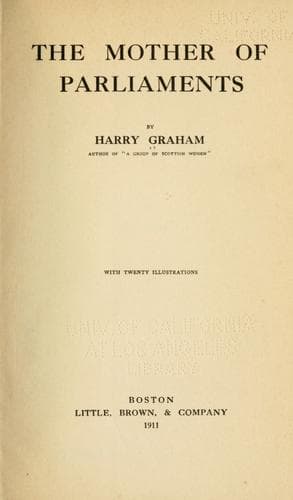
Great Britain. Parliament; Great Britain. Parliament -- History; Representative government and representation
The policy of Reform, on the other hand, is unacceptable to those who
desire the predominance of the First Chamber, as any successful scheme
for removing present defects in the constitution of the Lords--_e.g._
the excessive size of the House, the preponderance therein of one
party, and the presence of undesirable members--must result in its
increased strength and importance. Consequently the Commons have
neither made nor encouraged any attempts in that direction.
Such suggestions as have taken any shape have been proposed by the
Lords themselves, and the history of the last thirty years exhibits
many internal efforts to reform on the part of those dissatisfied with
the ancient constitution of the House. In 1884, Lord Rosebery's motion
for a Select Committee to consider the best means of promoting the
efficiency of the House of Lords, was negatived. Four years later he
moved for another Select Committee to inquire into the Constitution of
the House. In the same year an elaborate Bill of Lord Dunraven's for
reforming the Lords was rejected, and another, promoted by Lord
Salisbury, was withdrawn after having passed the second reading. In
1908 a committee met, under the chairmanship of Lord Rosebery, to look
into the whole question, and issued a most interesting and practical
report, full of admirable recommendations. This committee began by
pointing out the expediency of reducing the numbers of an assembly
which, within recent years has increased to such an extent as to
render itself too unwieldy for legislative purposes. It strongly urged
that the recommendations to the Crown for the creation of hereditary
peerages should be restricted within somewhat narrower limits. Many
peers, as the report explained, are obviously ill-suited to their
Parliamentary duties; others find the work irksome and distasteful; of
a few it may euphemistically be observed that their release from the
burden of legislative responsibilities would be eminently desirable.
Lord Rosebery's committee therefore came to the conclusion that the
dignity of a peer and the dignity of a Lord of Parliament should be
separate and distinct, and that, except in the case of peers of the
Blood Royal, the possession of a peerage should not necessarily be
attended with the right to sit and vote in the House of Lords. A
further suggestion was made that the hereditary peers should be
represented by two hundred of their number, elected by them to sit as
Lords of Parliament, not for life, but for each parliament, and that
the number of Spiritual Peers should be proportionately reduced to
ten. The inclusion of representatives from the Colonies, and the
granting of a writ of summons to a number of qualified persons who had
held high office in the State, figured prominently in this scheme of
reform.
Following up these recommendations, the House on the motion of Lord
Rosebery has recently adopted the following resolutions for its own
reconstitution:--
Public-domain text, read in full here on John Shaqi.
Reviews
Reviews
No reviews yet
Be the first to share your thoughts on this work.
Join the Discussion
Join the discussion
Sign in to leave a comment or review.
Sign InorCreate an account