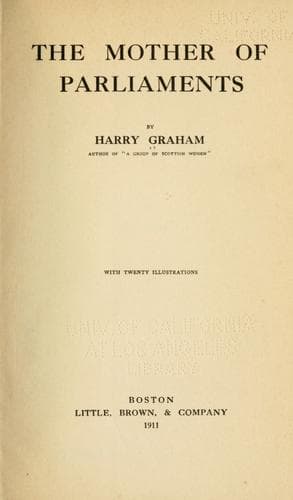
Great Britain. Parliament; Great Britain. Parliament -- History; Representative government and representation
The labours of Cabinet Ministers have increased enormously in modern
times. This is perhaps one of the reasons why they no longer deem it
necessary to attend debates as regularly as their predecessors. In
Disraeli's time all the members of the Cabinet sat on the Treasury
Bench throughout a debate, and listened attentively to every speech.
It was considered obligatory upon the Leader of the House to be
present perpetually in his place in Parliament. Neither Gladstone nor
Disraeli would have thought of leaving the Chamber, except for a
hurried dinner, until the House rose. The sittings have become so
lengthy of late that it would be impossible for any Minister thus to
give up his whole time to debate. Ministers are consequently provided
with private rooms within the precincts of the House, whither they
betake themselves as soon as question time is over, leaving one or two
of their number to act as sentinels.
The cup of a young politician's happiness is filled to the brim on
that glad day when he is offered a post in the Ministry. It does not
actually overflow until he has been given a seat in the Cabinet
itself. Should such success attend him, the summit of his ambition is
within sight. In imagination he sees the mantle of Walpole descending
upon his shoulders. Before his eyes stretches a vista of political
splendour which only reaches a glorious conclusion when the vaults of
Westminster Abbey open to receive his ashes. There is but one fly in
the ointment. A member of the House of Commons who is appointed to
ministerial office has perforce to submit himself once more to the
judgment of the electors, and beg his constituents to return him again
to Parliament. This rule is some two centuries old, and was designed
to prevent the corruption of unworthy members who might otherwise be
bought by the offer of lucrative Crown appointments.[150] It is no
longer of any practical value for this purpose, and so tiresome a
practice, entailing as it does much hardship and expense upon a newly
created Minister, could well be abolished. Old customs die hard,
however, and nowhere do they take so "unconscionably long a time
a-dying" as in Parliament.
[150] Exceptions are made by Statute in favour of the Secretary of the
Treasury and some other officers, or of a Minister who is transferred
from one office to another in the same Administration.
Public-domain text, read in full here on John Shaqi.
Reviews
Reviews
No reviews yet
Be the first to share your thoughts on this work.
Elsewhere in the archive
Join the Discussion
Join the discussion
Sign in to leave a comment or review.
Sign InorCreate an account