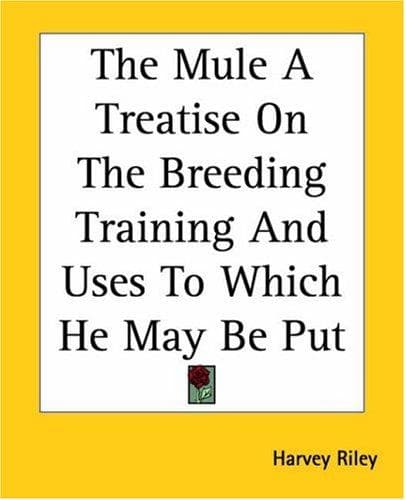
The Mule: A Treatise on the Breeding, Training, and Uses to Which He May Be Put — John Shaqi
The Mule: A Treatise on the Breeding, Training, and Uses to Which He May Be PutRiley, Harvey
History
The Mule: A Treatise on the Breeding, Training, and Uses to Which He May Be Put
Riley, Harvey
Mules
The most disagreeable and unmanageable, and I was going to say useless,
animal in the world, is a stud mule. They are no benefit to anybody, and
yet they are more troublesome than any other animal. They rarely ever
get fat, and are always fretting; and it is next to impossible to keep
them from breaking loose and getting at mares. Besides, they are
exceedingly dangerous to have amongst horses. They will frequently fly
at the horse, like a tiger, and bite, tear, and kick him to pieces. I
have known them to shut their eyes, become furious, and dash over both
man and beast to get at a mare. It is curious, also, that a white mare
seems to have the greatest attractions for them. I have known a stud
mule to take a fancy to a white mare, and it seemed impossible to keep
him away from her. Mules of all kinds, however, seem to have a peculiar
fancy for white mares and horses, and when this attachment is once
formed, it is almost impossible to separate them. If you want to drive a
herd of five hundred mules any distance, turn a white or gray mare in
among them for two or three days, and they will become so attached to
her that you may turn them out, and they will follow her anywhere. Just
let a man lead the mare, and with two men mounted you can manage the
whole herd almost as well as if they were in a team. Another way to lead
mules is, to put a bell on the mare's neck. The mules will listen for
that bell like a lot of school children, and will follow its tinkling,
with the same instinct.
Another curious thing about the mule is this: You may hitch him up
to-day for the first time, and he may become sullen and refuse to go a
step for you. This may be very provoking, and perhaps excite your
temper; but do not let it, for ten chances to one, if you take him out
of the harness to-day and put him in again to-morrow, that he will go
right off, and do any thing you want him. It is best always to get a
young mule well used to the harness before you try to work him in a
team. When you get him so that he is not afraid of the harness, you may
consider your mule two-thirds broke.
I have seen it asserted that a team of mules was more easily handled
than a team of horses. It is impossible that this can be so, for the
reason that you never can make a mule as bridle-wise as a horse. To
further prove that this cannot be so, let any reinsman put as many mules
together as there are horses in the "band wagon" of a show, or circus,
and see what he can do with them. There is not a driver living who can
rein them with the same safety that he can a horse, and for the very
reason, that whenever the mule finds that he has the advantage of you,
he will keep it in spite of all you can do.
Public-domain text, read in full here on John Shaqi.
Reviews
Reviews
No reviews yet
Be the first to share your thoughts on this work.
Join the Discussion
Join the discussion
Sign in to leave a comment or review.
Sign InorCreate an account